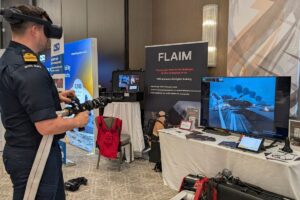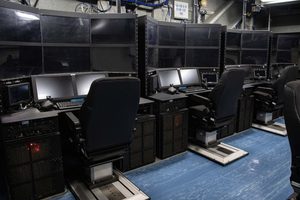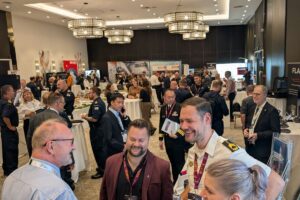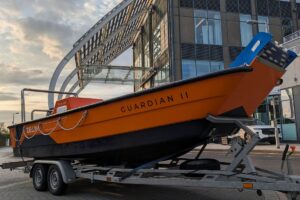
Our Naval Damage Control 2026 (NDC 2026) and Maritime Search And Rescue 2026 (MSAR 2026) conferences have come to an end, but what a ride!
Today the NDC conference had a flying start with a brief on the Royal Navy’s Hybrid Navy (HN) transformation and in particular its implications for platform survivability.
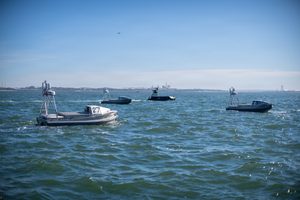
Arguably from a wider perspective the HN concept bring many benefits on its own terms. These include cost savings: as per RN analysis, the mix of Common Combat Vessels (CCVs) and large uncrewed surface vessels (LUSVs) is expected to come in at about 70% of exquisite assets in isolation such as Type 45 destroyers or Type 26 frigates, while providing comparable capability levels.
Other advantages include scalability, crewing, availability when considering new capability insertion, and force rationalisation: in other words, being able to provide the right capability in the right place at the right time.
But specifically addressing survivability, the speaker argued the HN concept holds many advantages over the existing model; he told the audience: “I think the HN is more survivable at every level.”
The basic premise is that at present, a significant and successful strike against a single exquisite asset such as a Type 45 “takes out sense, decide effect: while in the HN the hit takes out only one of those… taking out all three is harder.”
And in the HN model, any one of those three roles can be taken on by other platforms: even the “decide” element can be taken on by other CCVs, or potentially shore-based facilities in extremis.
The speaker declared: “I would rather have the HN construct, if you are facing an attack.”
There was acknowledgement of risks that need to be mitigated, not least among them overcoming communication hurdles. If CCVs and LUSVs are to sail together and operate as mini task groups, their ability to seamlessly transfer data, both for sensing inputs and tasking outputs, is crucial.
The audience heard: “Jamming a task group at sea is quite difficult, if not impossible; the CCV is there to be the louder, noisier thing to overcome jamming issues.”
Point-to-point laser communication solutions can also help to overcome any adversary’s electronic warfare efforts.
There’s a reputational risk to the RN, too: what if we get it wrong? “In my mind, the bigger risk is to fail to deter the next war, or to lose it.”
Overall, the speaker told the audience: “This puts us back on track to get to the levels of capability we know we need.”
Part of the challenge is thinking about uncrewed platform survivability, damage control, and design in a different way, the audience heard.
“Can we honeycomb below the waterline, so it doesn’t matter if it gets holed and water comes in? If it’s uncrewed, why would it need oxygen in it? Why not nitrogen? Why would it catch fire? What freedoms does moving to an uncrewed platform actually give us?”
A fascinating and wide-ranging Q&A session following the presentation took in a number of issues, including the risks of signal emissions betraying position.
While point-to-point laser comms were part of the answer, in time increased autonomy was another path to lower levels of required signals: uncrewed assets will be given a mission and parameters and will decide how to execute it themselves.
Looking for closely at the transition, the timeline for the introduction of HN has been carefully timed, the speaker said, to ensure that at no point will there be a dip in capability below what the RN already fields; Type 45s will be the first CCVs and pairing them with LUSVs will only enhance capabilities.
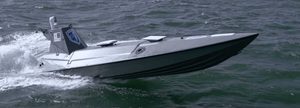
Questioned about overcoming regulatory hurdles, the speaker said the RN had already launched its LUSV-A programme, with a hull in the water scheduled for September 2027.
The size of the vessel will be more than 24 metres long specifically to tackle the existing regulatory issues and pave the way for even larger uncrewed vessels to come, perhaps up to 100 metres long.
The speaker again accepted there are risks involved, but also observed: “The safest thing to do is to stay at home — until we get invaded.”
A later presentation tackled the Fremantle Highway container ship transporting almost 3,000 vehicles, which caught fire off the coast of the Netherlands in July 2023.
The speaker started with a striking rhetorical question: “When it comes into harbour, what do you do with a burning ship? Nobody knows.”
The incident started just after 11pm on 25/7/2023, at that point a small fire at sea: the captain chose not to call the coastguard.
However, the fire escalated rapidly and by 2:20am the next morning the captain was requesting evacuation with smoke and flames approaching the bridge.
Striking aspects of this incident included the risk of the vessel sinking, having drifted without power, in an area that threatened Dutch undersea gas pipelines.
One surprising aspect was that to this day we have no idea how many electric vehicles (EVs) were on board; the first estimate was just 25 vessels.
However, over the course of the two-week incident ten different versions of the cargo manifest were provided to the authorities… the last estimate was that there were in excess of 500 EVs embarked, including five electric lorries, going some way to explaining why the fire burned for so long and with such ferocity.
Problems faced during the salvage operation included how to attach tow ropes to a still-burning vessel, and who made the decision allowing a burning ship to be towed into the nearest suitable harbour — in this instance Delfzijl, against the wishes of the town’s mayor.
Lessons learned included the importance of keeping a helicopter available for SAR, and the need to establish live video feeds of ongoing incidents to enable tactical decisions to be made about firefighting.
Accurate cargo manifests are needed as early as possible so firefighters know what they’re up against; and crews dealing with incidents should be prepared to challenge existing policies and regulations if necessary.
As the speaker summarised: “Technology is advancing faster than legislation can keep up.”
In the MSAR conference, delegates heard about the challenges involved in building SAR capacity in low-resource areas, with specific reference to the MSAR Council’s outreach work in a deliberately unspecified West African coastal nation.
Issues included a lack of trust between fishing communities and national maritime agencies, especially among more remote settlements away from the capital.
That isolation was in itself a stumbling-block: even some of the nearer communities could take six hours to reach by road in a 4×4 vehicle even in the dry season; in the rainy seasons the roads became completely impassable and communities were effectively cut off.
The speaker noted: “The SAR system may exist, but for many fishers, it’s not yet practically accessible.”
Simply throwing money at the problems would not be the answer, even were adequate funding available — the infrastructure to support new technologies is not available, and to some extent a culture shift is needed.
For instance, many fishers had lifejackets available, but didn’t habitually wear them. The work of the MSAR Council in this regions included “Float to live” (F2L) training sessions — especially pertinent in locations where people knew that in all likelihood, rescue wouldn’t come.
And the speaker concluded on an upbeat note, recounting a tale where shortly after the team had left, a fisherman involved in a boating accident had survived in the water for four days before rescue, in part directly because of the F2L sessions delivered shortly beforehand.
He said: “That is success, because it is a life that has been saved by an intervention.”
Back in the NDC conference, the final session concluded with an examination of the lessons to be learned from the near-loss of Royal Navy vessel HMS Endurance, which suffered a severe engine room flood off Chile in December 2008 during routine maintenance, nearly sinking the ship.
The speaker gave a blow-by-blow, virtual minute-by-minute account, by turns funny and shocking, of the incident and the decisions that had to be taken as the potential loss of the vessel had to be contemplated, but if possible avoided.
A retelling in a summary article as this can hardly do it justice, but there were plenty of stand-out moments that resonated with all lucky enough to be in the room and listening… I include a few of them below:
“The first sense I had that all was not well was when I heard ‘Casualty in the engine room’ immediately followed by, ‘Flood in the engine room!’ in a tone of voice that was instantly recognisable.”
“I thought, if we don’t stop that, we are going to sink… Immediately I thought we are going to lose the engine room, and if we lose the engine room, we are going to sink.”
“Probably 20 people on the ship appreciated the seriousness of the situation at that stage.”
“There was zero redundancy, the systems were not instinctive, and a lot of the instruction manuals were in Norwegian.”
“I had told the captain it was going to be fine… I didn’t even have his phone number!”
I never really had a sense of fear or panic… I was too busy.”
“After 15 minutes we had lost power… we had 1,200 tonnes of water on board, and we went on beam on… we started to roll 30 degrees either side of vertical, about every ten seconds.”
“The Nelsonian idea of the loneliness of command I don’t agree with.”
“One of the bleakest moments was putting out a mayday on Channel 16 and no-one answered, because no-one was there.”
“After 30 minutes it was more about damage containment than damage control.”
“I remember looking out of the window thinking, ‘How do we do that? How do we abandon ship? The wind is about 50-60 knots… chutes aren’t going to work. Could we carry lifeboats and launch them off the stern? That was pretty low in the water… we had rubber rings, there were rocks, and the water temperature was about 1C.”
Despite all the above, suffice to say the tale ended happily and the ship was not lost. The speaker’s main takeaways were that the RN needs to work on truly learning lessons on a corporate level, and that trusting your team was imperative.
All the presentations in both conference theatres over these last three days have consistently provided thought-provoking content and jumping-off points for continued debate. And the events have also provided ample opportunities to network and make useful industry contacts in our exhibition halls.
It’s been a productive and fascinating few days in Southampton; Navy Leaders extends its thanks to all attendees, presenters, exhibitors and delegates alike. We sincerely hope we see you all again in 2027!