The U.S. Navy has hailed the success of recent tests proving drones don’t need Global Navigation Satellite Systems (GNSS) to land safely on moving ship platforms.
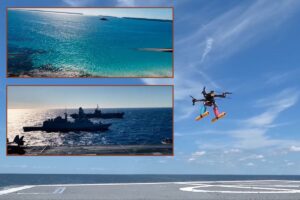
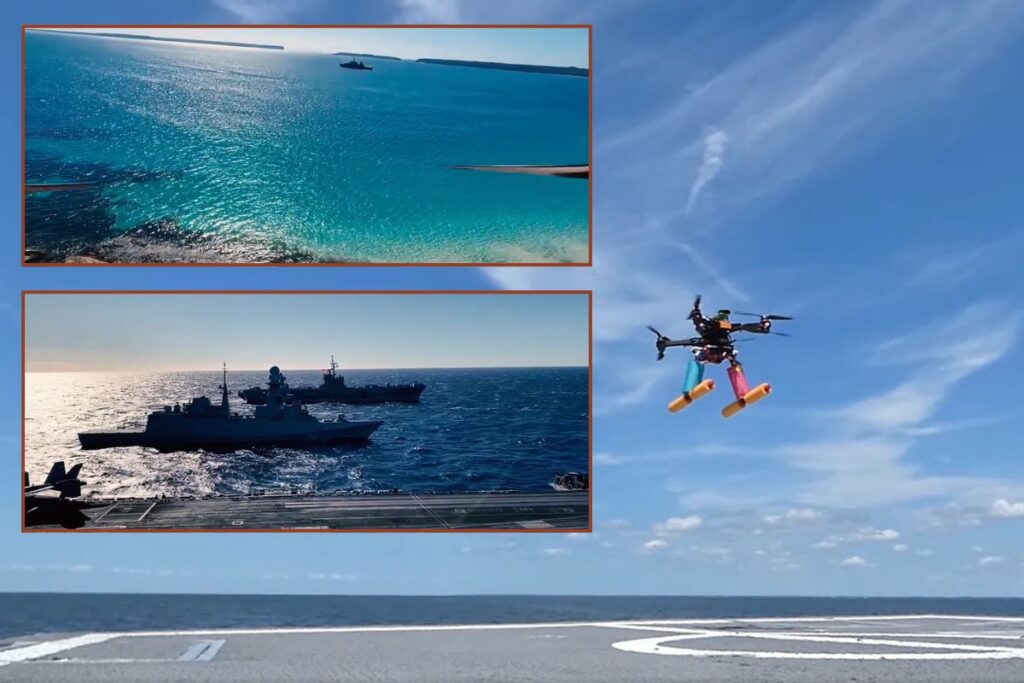
In recent experiments carried out by the Naval Air Warfare Center Aircraft Division (NAWCAD) an uncrewed aerial system (UAS) autonomously completed missions and then landed aboard Navy ships on a pitching vessel at sea using only its own sensors and control suite.
NAWCAD commander Rear Admiral Todd Evans commented: “In contested areas where satellites and communications are jammed, autonomy gives significant advantage to our sailors. Breakthroughs like this help us scale unmanned capability fast and affordably across a distributed fleet.”
As per a NAWCAD statement: “In flight, the aircraft uses its camera to recognize a ship’s shape and visual cues to guide its flight path like a human pilot, while its guidance and control algorithms predict the ship’s deck movements in real time, so the aircraft can touch down smoothly.”
It said the software used to affect the landings was compatible with nearly any UAS hardware and could support uncrewed systems of all sizes, from large, combat-class fixed-wing airfames down to small quadcopters.
NAWCAD now plans to roll out the system for operational testing, with an initial focus on adapting the technology to larger UAS, including logistical resupply drones.
- You can read more details on the U.S. DoW website