“If the war in the Black Sea has taught me anything, it’s that naval damage control has become even more important.”
These words, spoken in the initial presentation delivered at Navy Leaders’ Naval Damage Control 2026 (NDC 2026) conference, served as an apposite summary of the relevance of this year’s event.
Over the next three days more than 600 delegates are expected to descend on Hilton Southampton – Utilita Bowl for NDC 2026 and its sister event staged side by side, Maritime Search And Rescue 2026.
At NDC 2026 we kicked off with a session looking at lessons to be gleaned from the war in the Black Sea, which the speaker characterised as “all about a fight for survival, and keeping sea lines of communication open.”
Among the many salient points dished out to a packed and attentive room were that the age of mines, and dealing with mines, has returned. One important lesson for damage control going forward is the necessity of a renewed focus on shockwave impacts on vessel integrity.
After Ukraine had successfully waged its USV campaign to fend off the Russian Black Sea fleet and force it back into harbour in Novorossiysk, the Russians decided attacking the grain supply in and out of Odesa was the way forward. The speaker observed: “This is now a total war; they are trying to strangle Ukraine out of existence.”
One of the lessons of the multiple strikes on merchant vessels by missiles, UAS and USVs, the audience heard, was this: “These are very survivable hits — if we get our damage control right.”
All the same, “Gone are the days when you are going to get hit by two or three missiles or drones: they are going to send 50+ with smaller payloads.”
Part of the answer was a layered air defence system, with a mix of gunnery, interceptor drones and higher-end systems such as Patriots reserved for tackling the fastest incoming threats.
Another lesson was that ships needed to think about survivability and damage control not just at sea but when moored alongside in port, too: “We have spent a long time defending ourselves from terrorists on the jetty… now we need to look out to sea as well.”
And Western nations need to find new ways to prepare sailors for the psychological stresses of conflict. The Ukrainian experience was that about 15% of personnel tended to freeze when they came under fire for the first time.
A later presentation built on these points with a discussion of ship design considerations for protection against uncrewed one-way attack UxVs.
“Damage control is changing because the threat environment is changing,” the audience heard: there has been a huge evolution in the last decade, and these are not the types of weapons we have faced in the past.
Uncrewed systems as attack vectors have been embraced not just by insurgent groups but by front-line navies too. As a rule of thumb, uncrewed systems (UxVs) are smaller, cheaper, slower, and lower, with smaller explosive payload weights, and they frequently exploit existing commercially available technology.
Their slow terminal engagement speeds — typically under 200 knots for UAS, and under 67 knots for USVs — mean it’s unlikely that they will be capable of penetrating a hull: the expectation is that they will detonate outside.
This may lead to localised “dishing” of hull structure, with possible small shock holes, and limited internal blast damage. Rather, UxV attacks rely on secondary damage effects: starting fires and causing flooding with concomitant potential loss of platform buoyancy and compromised stability.
UxV attacks are being deployed against both commercial and military targets, and the objectives can be sea denial and/or distraction from clandestine actions elsewhere.
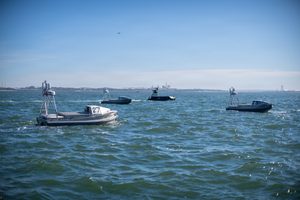
The likelihood is UxVs will be used in coordinated swarm attacks; large numbers of UxVs can potentially overwhelm countermeasures and stress the damage-control measures of platforms, particularly if attacks are distributed along the full length of a target.
Traditional damage control measures have assumed countering a strike in a single location — this is no longer likely.
What are the solutions? The speaker suggested starting with better countermeasures to prevent the strike in the first place. There will be a need for reliance on automation, especially with lean-crewing considerations.
The speaker concluded UxV attacks were best characterised as “death by a thousand cuts.” No single strike is likely to prove lethal, but multiple attacks can easily degrade platform effectiveness, and enough strikes could still prove fatal.
There was also an insightful presentation on survivability concepts in the context of the Royal Navy’s shift to a Hybrid Navy survivability.
This wasn’t just about smaller drones, the speaker reminded us: “What we are working on at the moment is vessels above 25m long, up to 100m long, and fully uncrewed, with effectors, and networked with our crewed assets.”
In terms of timelines, the first in-water demonstrations are due next year. A USV accelerator programme is on the horizon, and the aim is to have assets such as Type 91 missile barges in the water by about 2030.
The uncrewed focus means damage control priorities can shift from preserving life to preserving the platform. But who saves the ship when no-one is on board?
There’s a need, delegates heard, to examine what types of technology to employ on UxVs, and how. Fixed fire systems are going to feature: sensors for detection of fire and gas, automatic detection and release suppression systems.
Other considerations included how to stop the enemy from seizing systems and data, and how and where to employ novel technologies such as self-healing bulkheads: where do we use them, and at what cost? And what scope is there for robotics in future damage-control scenarios?
There’s also a need to address what attritability means in practice. Losing an eight-metre USV might not be the end of the world or significantly impact overall capability, whereas losing an aircraft carrier or Type 45 destroyer would be an unthinkable loss. The loss of large USVs such as Type 91 missile barge would fall somewhere between those two extremes.
A lively Q&A exchange at the end of the presentation also covered ongoing training: for example, we learned the RN has already trained 120 officers in remote-operated surface warfare assets under Project Beehive.
Also mooted was the need for changes to where we base these uncrewed assets and how we protect them while they sit alongside. Is there a need for enhanced harbour protection measures and picketing of sea accesses to counter potential drone attacks?
In the MSAR 26 conference theatre, among the many insightful presentations was one on the ongoing transformation and modernisation of the RNLI.
In recent times 98% of the RNLI’s lifeboat responses are now within 10nm of shore: it needs to innovate and transform to meet this shift.
It’s taking, delegates were told, a define-the-problem-first approach, and letting the people who use the equipment decide. And once the tech has landed, it needs to be ever-evolving. In other words, keep asking the question: How can we be better?
Among the case studies highlighted was the introduction of new coastal lifeboats. As the RNLI is as a general rule now operating much closer to shore, it needs an appropriate platform: an intermediate size to answer future demand. Two prototypes are due to be introduced in 2027.
Also cited was the roll-out of the Atlantic 85 Mk4 lifeboats, with two prototypes being trialled now, four next year, and a fleet roll-out from 2028. These are an evolution of an existing design, focused on reducing whole-body vibration and fatigue on long, rough passages, and easier casualty recovery.
Staying with MSAR, another presentation addressed developing a common SAR framework for the Baltic. The assembled audience heard the Baltic region has nine coastal states and 2,000 ship movements at any given time.
There are existing bilateral agreements and help always offered on request, but no Baltic-wide proactive planning at present. How could we do this better?
Possible actions include real-time information-sharing of capabilities and availability (starting with helicopters, but potentially extended to surface ships too), along with coordinated planned availability and downtime to manage gaps in provision.
Potential obstacles include existing information-sharing technologies that don’t necessarily match up; security considerations for military-adjacent activities; and cultural barriers.
On the other hand, recent potential enablers include new states joining NATO, the increased likelihood of accidents, and the rise of shadow fleet threats providing extra motivation.
Back in the NDC 2026 conference, one afternoon session took in using wargaming as a naval damage control instructional tool.
Intended to teach people rudimentary damage control principles, it was originally created to be a training aid for students, but now navies are expressing interest in adopting it. Both analogue board-based and now Claude-coded digital versions are available.
Key ideas include highlighting the need for rapid decision-making; and the limitations on resources including damage control teams, shores, and even breathable air.
The game forces players into difficult decisions: save the casualty, fight the fire, or restart the pumps to deal with flooding?
Its advantages include learning through play and providing a safe place to fail. Decisions are logged for review and discussion, while games can be repeated to reinforce learning or test whether other courses of action would produce better outcomes.
In the MSAR 2026 conference, Day One rounded off with a presentation about designing rescue boats for mass-rescue operations (MROs).
The audience was told SOS Mediterranee has accumulated vast experience in this field, with circa 43,000 people rescued, using about nine different types of boat.
Aims of the presentation included helping make good decisions designing new platforms, because “there are lots of existing boats that don’t do basic tasks well.”
The speaker wanted to demonstrate the value of small platforms for MROs, show how to manage the risks for those being rescued and their rescuers, and demonstrate the sheer physical effort involved.
Harrowing video footage was shown which showed incidents where overloaded and collapsing small boats had resulted in deaths from crushing and drowning, and severe injuries due to chemical burns from fuel.
The speaker talked about the ‘bottleneck’ moments in MROs: getting people in distress onto rescue platforms, and then off the rescue boats onto motherships to take them to safety.
It took in the importance of stabilisation tactics (getting everyone afloat in the water with lifejackets or floats) and good crowd control to reduce panic and effect an efficient rescue.
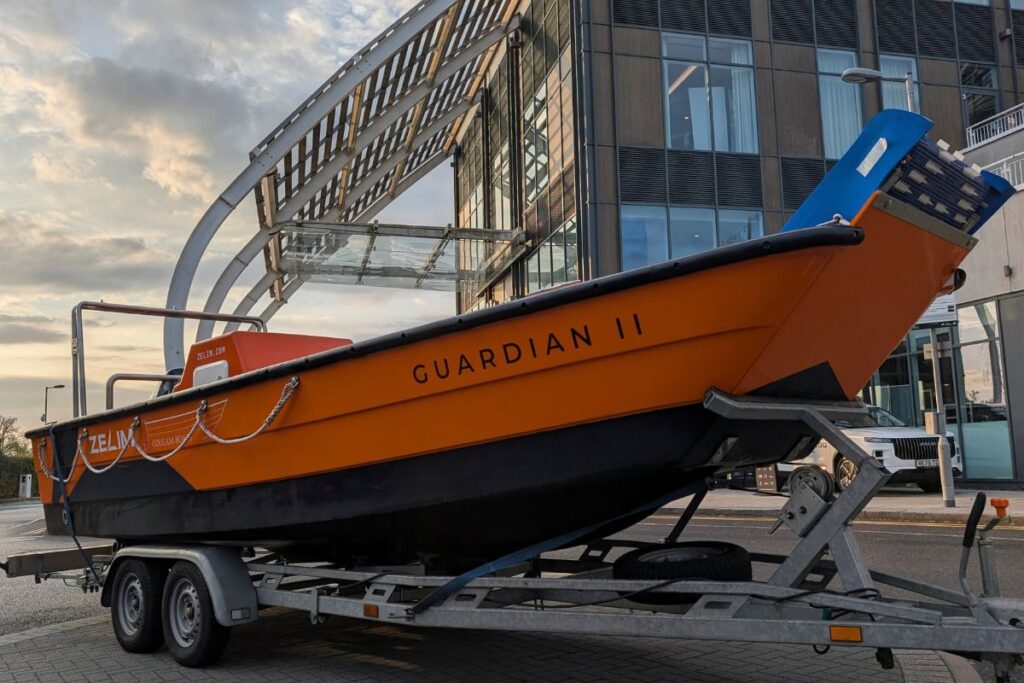
Important design aspects for rescue boats for optimal MRO efficiency included a manoeuvrable platform, powerful motors, and low freeboards the length of the vessel to enable easier casualty recovery.
A deck wide enough to have two rescuers working side by side is also desirable, as is a raised driving position for visibility, and located aft so casualties can be offloaded to a mothership easily from the bow, even by stretcher.
As ever, there was far more discussed across the course of the day than could be encapsulated in any written summary, let alone this short synopsis — which is why attending in person is the optimal strategy!
We hope and confidently predict that days #2 and #3 will prove equally thought-provoking and rewarding.