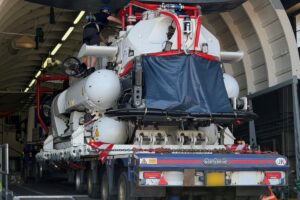
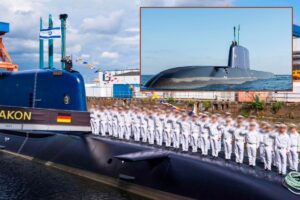
The German Navy has just taken delivery of its first large uncrewed underwater vehicle (LUUV) — the Blue Whale autonomous drone developed by IAI and TKMS.
Designed as a platform for long-range intelligence, surveillance and reconnaissance (ISR) missions, the autonomous LUUV is just under 11 metres long, a little over a metre wide, and weighs about 5.5 tons.
Already being operated by Israel’s naval forces, it was developed by Israel Aerospace Industries ELTA and TKMS subsidiary Atlas Elektronik.
An IAI statement noted: “BlueWhale is a mature, first-of-its-kind fully autonomous large underwater vehicle that combines reconnaissance, sensor technology, and data fusion in a single system.
“[It has been]… developed by IAI, a leading global provider of aerospace and defence systems. TKMS and its Atlas Elektronik segment integrated the advanced anti-submarine warfare towed sonar.”
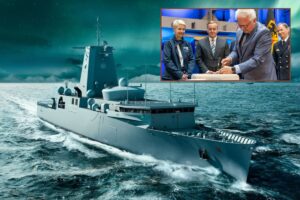
The first of “several” Blue Whale LUUVs destined for the Bundeswehr was handed over to the Germany Navy at a ceremony in Eckernförde in northern Germany on Wednesday.
It followed a series of successful tests carried out in the Baltic Sea in November 2024, where the drone was used to locate and track underwater targets, and covertly gather intelligence on surface vessels.
Because it is uncrewed, the drone can more easily be deployed closer to immediate threats. The LUUV carries state-of-the-art sonar- and satellite-based sensors for gathering information both above and below the water.
As well as conducting reconnaissance operations, and detecting targets above and below the sea surface, the LUUV is capable of collecting acoustic information, and locating sea mines on the seabed.
As per a German Navy statement: “The tests in Germany were so convincing that the decision to procure several units was quickly made.”
Germany’s Inspector of the Navy, Vice Admiral Jan Christian Kaack commented: “We have relied on proven technology on the market, radically shortened decision-making processes, and involved the troops in the procurement process from the very beginning. And all this in just a few months instead of years.”
He added: “The development of a hybrid fleet starts right now.”
- You can read more details on the German Navy website and the IAI website