A ministerial address… a representative from Ukraine’s Unmanned Systems Forces… What final day we’ve had at CNE 2026!
Proceedings opened with a speech from the U.K. Government Minister for Defence Readiness and Industry, Luke Pollard, who, mindful of who was scheduled to follow him on the podium, told a packed auditorium: “Ukraine’s security is our security… we will stand with you for as long as it takes.”
He told the audience: “I want a thousand-ship navy, but I want most of those ships to be uncrewed… We have been locked in to a narrative of how many crewed platforms we have for too long: I want us to expand our thinking.”
And he added: “We only need to look at what Ukraine have done.I can see the evidence with my own eyes; we can all see the direction of travel… If it doesn’t work in Ukraine, I don’t want to buy it here.”
The minster was immediately followed by a special guest we’re neither naming nor picturing for operational security reasons: a representative from Ukraine’s Unmanned Systems Forces.
The briefing given, too, was off the record, but we can say it took in the background to, and current and future capabilities of, Ukraine’s maritime uncrewed systems. We can also reveal the end of his speech was met with a heartfelt and immediate standing ovation.
After that electric start, the conference again split into streams for the rest of the morning session. Among the many presentations on offer was a second briefing from HI Sutton. Yesterday’s had been focused on Russian platforms; today’s was centred on the latest Chinese capabilities and lines of effort.
The audience heard about China’s various classes of submarines already fielding hypersonic missiles. One such type’s first-in-class boat was only launched in 2022; there are now thought to be already between six and eight of them in service.
“They are building at an incredible rate,” the audience heard. “This is likely to be a recurring theme throughout this presentation.”
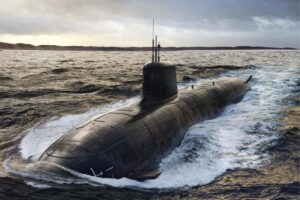
Delegates also heard about another new high-performance underwater platform with similar dimensions to the U.S. Seawolf-class boats: 108m long with an optimal 9:1 length-to-beam ratio. This new sub also features a vertical launch system for its missiles, again likely hypersonic in nature.
Other novel capabilities included an air-independent propulsion (AIP) boat whose batteries were charged using an onboard nuclear reactor for unlimited range: “Not the first country to think about it, but definitely the first to make it operational.”
Mention was also made of a new semi-submersible arsenal ship, likely with pop-up VLS capability; invasion barges that are thought to not a one-off design, but part of the maritime force; and very large hovercraft that would prove extremely useful in both assault and immediate resupply phases of operations.
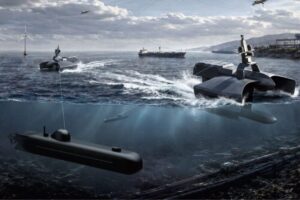
The audience was told, too, that China was “ahead of the West” in its development and production of UUVs, including XLUUVs. Some of these were the size of Western platforms such as the RN’s XV Excalibur and Boeing’s Orca; others were larger still. At least two types are comparable in size to crewed submarines.
The most likely explanation of why these outsized underwater drones are being developed, the audience heard, was range: the largest platforms could have ranges of up to 10,000 nautical miles, meaning they could sail on return trips to (for example) part of America’s Western Pacific coast, or even as one-way effectors to Los Angeles or the Panama Canal.
In another theatre there was a presentation by Ulrik Sköldkvist, Project Manager UW Weapons Systems, in the Swedish FMV, on countering underwater threats in the Baltic Sea and Sweden’s current and future undersea warfare capabilities.
He talked about Saab AUV62, which the Swedish Navy has been operating and continuously updating over the last decade. Future lines of effort include launching and recovering unassisted from its submarines: “We are getting there,” delegates were told.
Work is also ongoing on Saab’s six-metre LUUV, under development for almost 12 months. “They are building the first prototype right now… we will have it in the water this year.”
Its design and dimensions mean as well as being launched pierside, it will also be able to be deployed from the large payload bay of Sweden’s future Blekinge-class submarines.
Other future lines of effort include trialling underwater gliders with acoustic detection systems for ASW in the challenging noisy, shallow and busy waters of the Baltic Sea; operating AUVs with towed array sonar (TAS) systems, and continued participation in initiatives such as Task Force X Baltic, and the forthcoming Task Force X Arctic next year.
A later presentation took in future above-water capability and surface ships for the Royal Australian Navy. The audience heard an update on the Hunter class ships, using the same platform as British Type 26 frigates: the first-in-class is on track to be completed in 2032, and at full operating capability by 2034.
It will be optimised to use a range of American and Australian systems. The speaker said: “We continue to evolve this class even while it is in build; for example SM6 will go into this class. The Government is looking at if it will get Tomahawk land-attack missiles; it will get the Naval Strike Missile.”
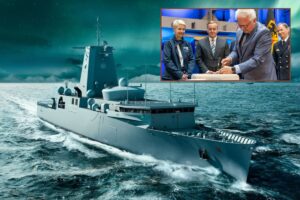
The audience also heard about the RAN’s decision to acquire Evolved or Upgraded Mogami-class frigates. These were being acquired on an off-the-shelf basis for speed of delivery: “It is a very capable ship as it is.”
The first of three initial ships being built in Japan is set to arrive in 2029, with only very minor changes, such as signage and computer systems being in English, not Japanese! The first Australian-built Mogami frigate is set to roll off the production line in 2033.
There was also mention of the Australian Army’s programme to acquire 18 Medium and 8 Heavy Littoral Landing Craft, and relocation of the majority of these new platforms towards the north of the country to move them closer to the environments in which they are expected to operate.
Rapidly switching focus to the other side of the world, in another theatre there was a presentation by the RN’s Naval Base Commander Portsmouth, Commodore Marcel Rosenberg, on the Portsmouth Capability Accelerator.
Addressing the work to introduce a naval innovation hub, he told the audience that the RN’s transition to a Hybrid Navy was “the greatest pivot since going from sail to steam.”
He added: “We cannot afford to continue to be drowned by our own processes… The Hybrid Navy is not an end state, it is a mindset.”
The innovation hub’s physical manifestation will open inside the naval base by the end of the summer, and will support the RN’s efforts at REPMUS in Portugal in the autumn.
Moving forward the approach will be to think big, start small and scale fast. The audience was told that defence as an institution had a passive approach to risk that needed to change. Accepting manageable risk was necessary, because we are also putting sailors at risk every day if we are sending them to sea with outdated equipment.
Then in the final stages, delegates came back together for the last afternoon’s twin plenary sessions. In one, Vice Admiral Markku Hassinen, Chief of the Border Guard, Finnish Border Guard gave a talk addressing grey-zone threats in the maritime domain.
He told how the maritime domain had become a permanent frontline, commenting: “The line between safety-related operations and security operations has already blurred.”
And he noted: “We need to be prepared to protect our maritime borders and airspace against drones…. A clear and present danger. Armed drones were flying over Finnish cities just weeks ago.”
Referencing recent damage to critical undersea infrastructure (CUI) in the Baltic, and the steps Finland had taken to react to these incidents, he said the approach had been: “Halt the illegal activity, avoid additional damage, and have a credible response.”
The vice admiral added: “The challenge is…looking to respond without escalating the situation.”
The solution to this thorny problem lies not in one sensor or platform, but by the coherence of a whole system, including a Maritime Domain Awareness (MDA) which fuses both national and international intelligence sources with commercial data sources wherever possible: “We can only identify abnormal behaviour when we know what is normal.”
Key elements of a suitable response require not just situational awareness but also clarity of legal jurisdiction, unity of command, and availability of necessary assets.
He asserted: “These relationships and lines of communication have to exist before any kind of incident, because they cannot be improvised in the moment.”
Later, the RN’s Director Acquisition Rear Admiral Matthew Stratton talked more about the Hybrid Navy vision and turning it into fielded combat power.
“We are operating a world that is more complex, contested, and moving at a greater pace than at any time in history,” he said.
“Hybrid Navy is fundamentally simple: crewed where necessary, uncrewed where possible, and integrated… The question is, how do we deliver it at pace, at scale and in partnership?”
And he noted: “Martec’s Law states that technology changes exponentially, but organizations change logarithmically.. And that gap is where failure awaits us. The risk is that we acquire but fail to test and exploit it… that is a leadership challenge.”
In a Q&A session after his speech he said a new RN catchphrase should be “complex where necessary, simple where possible” to avoid a natural tendency to overcomplicate, and that more attention needed to be paid to the Maritime Fighting Web.
And he declared: “The Hybrid Navy is not just a future aspiration: it is already being delivered.”
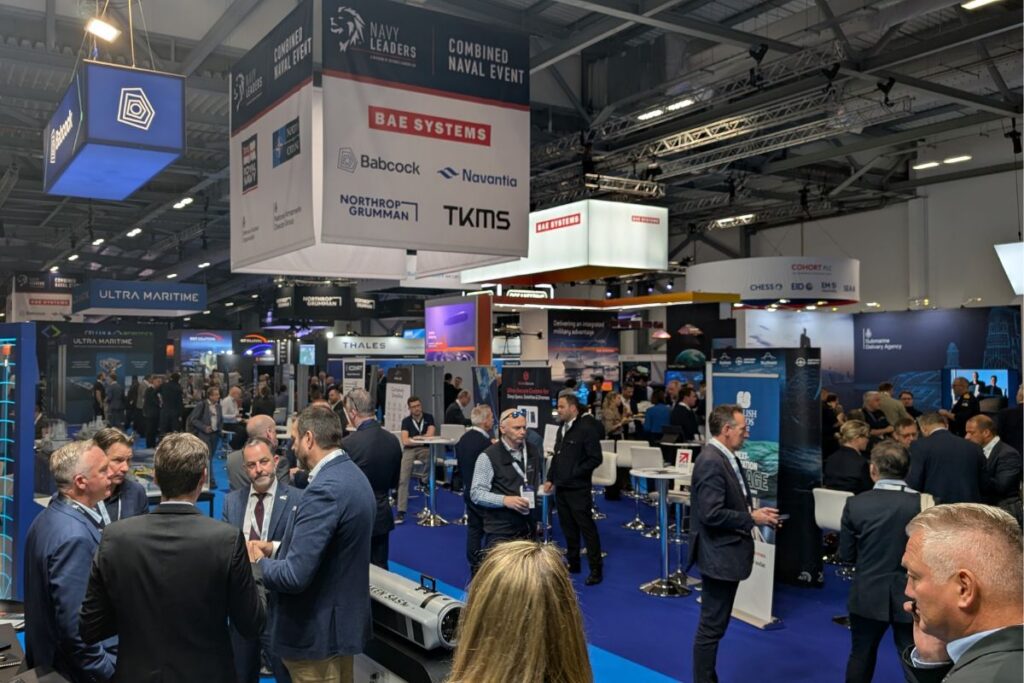
His presentation was a fitting full-circle end to a three-day event where more than 3,000 people have passed through the doors of the International Exhibition and Conference Centre in Farnborough, U.K. They can’t fail to have been impressed by the sheer breadth and quality of content they have encountered.
Alongside the excellent presentations, attendees have enjoyed interacting with the 200+ industry exhibitors showcasing their latest equipment throughout the main hall.
There’s no question that the 12th iteration of CNE has had a larger global reach than ever before, with representatives from 86 nations across the world drawn to the largest annual naval event in Europe.
Navy Leaders would like to extend its thanks to every single person and company which has contributed towards making CNE 2026 an unrivalled success. And with the vast majority of firms having already rebooked for 2027, next year’s event is promising to somehow be bigger yet. See you there!