“CNE is rightly seen as a key event in the calendar, and its focus couldn’t be more relevant.”
These were the words of First Sea Lord (FSL) General Sir Gwyn Jenkins as the head of the Royal Navy delivered the keynote speech on the first day of the 2026 Combined Naval Event at Farnborough.
His hard-hitting address referenced a peace dividend that “seems like a distant memory”; a “fraying” rules-based international order and “a new era of increased state-on-state confrontation.” Nor did he forget to reference Ukraine, calling it “the most attritional and bloody conflict since WW2.”
As he observed, the U.K.’s ability to endure two world wars had stemmed largely from her naval power; he quoted Sir Dudley Pound, First Sea Lord from June 1939 until August 1943: “If we lose at sea, we lose the war.”
The FSL added: “That is why we need Hybrid Navy… We are at a fork in the road, and the decisions we take now will have seismic and lasting consequences.”
And he asserted: “I accept that there are still some hybrid sceptics, but here’s the hard news: we have no time to pander to cynicism or traditionalists, because autonomy is already demonstrably changing the nature of warfare, as evidenced in Ukraine and in the Middle East.”
And the FSL again championed the U.K.-led Northern Navies initiative involving members of the Joint Expeditionary Force (JEF). Now moving into the next phase, he said navy chiefs were meeting on its again in the coming weeks and a full plan would be ready for implementation by autumn.
He concluded: “The battle for the Atlantic never went away… It has evolved, and if it gets hot, we have to be ready.”
But the keynote speech was just the opening salvo of a packed first day at CNE that also featured presentations from RN Admiral Sir Keith Blount, Former Deputy Supreme Allied Commander Europe, NATO and a host of other stellar names.
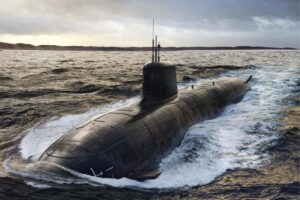
There were presentations on the role of the RN’s crewed submarine in the future underwater battlespace. The audience was told: “The crewed submarine is not becoming less relevant, it is becoming more central, but it must adapt and become the centre of a system.”
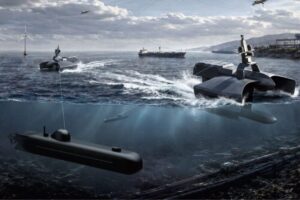
The submarine, said the speaker, must become the orchestrator of a wider undersea system, the centre of a distributed network coordinating uncrewed platforms. It is still a strategic instrument in maintaining deterrence: “Uncertainty remains one of its most potent weapons.”
It was confirmed in the same presentation that SSN AUKUS submarines would be able to deploy a range of uncrewed systems, including larger platforms from vertical launch tubes.
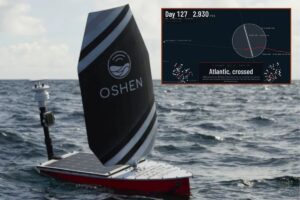
And the speaker also announced that RN XLUUVs could in future potentially be capable of delivering lethal effects: “Sense alone is not enough: we must ensure future systems can deliver effects at scale.”
Later, an U.S. Navy presentation on growing asymmetric advantage in undersea warfare acknowledged that seabed warfare capabilities were a huge growth area for America, in particular XLUUVs: “We need to talk about dominating the seabed.”
The audience heard partly the approach was messaging about “what we already have.” There were more than 20 subs at sea globally, he said, and publicly announced visits of American SSBNs to Faslane in Scotland and Gibraltar at the entrance to the Mediterranean were a part of that strategy.
He said the U.S. was deploying seabed warfare today for survey, attribution, and the whole spectrum of operations, and that the drive going forward was to ensure that this wasn’t episodic and occasional, but an enduring part of everyday procedures.
Another strand was ensuring preparedness, with the aspiration being that 80% of capabilities were “combat-surge ready” at any given moment.
Key lines of effort were best characterised by the twin aims of closing the “Blue” kill chain, and breaking the “Red” kill chain.
Defending critical undersea infrastructure (CUI) had to be another priority, he said, with trade measured in “trillions of dollars” dependent on it. Meanwhile cross-domain C2, precision timing and underwater communications represented “our most significant line of effort.”
It was also revealed that America’s first Columbia-class SSBN was on track to be pressure-hull complete by the end of this calendar year and at sea and on patrol by the end of the decade, while the first Block V Virginia-class boat, USS Oklahoma, was also “back on schedule.”
It was vital that future SSN-AUKUS boats were as compatible as possible with Virginia-class subs, even on an individual component level, and that a best-of-breed approach to system capabilities was taken across nations going forward.
Equally, expeditionary use of advanced and additive manufacturing techniques, and using them to build up supplies of critical spares, was another important line of future effort.
The audience heard AI copilots for each operator were already being trialled on Virginia-class subs, and that going forward AI should also be used to move away from calendar-based maintenance schedules towards a predictive approach instead.
This afternoon a presentation on modernising Brazilian naval power began by giving some eye-opening context outlining its areas of responsibilities: 55 million sq km of waters under Brazilian jurisdiction; 60,000km of navigable waterways; and 14.5 sq km SAR area.
At present Brazil’s navy is assessing what kinds of uncrewed systems it should acquire and develop to help police such a wide operational area.
The presentation also took in its new Rinamil-class OPVs, 500-tonne, 59m vessels intended for everything from naval defence to SAR and disaster relief. The first of 11 ships is already delivered, the second will follow at the end of this year, and the other nine by 2040.
A new Antarctic vessel to support its 44-year-and-counting programme is due to be launched October 2026, with delivery scheduled for April 2027; there are also ongoing plans for a logistics support vessel.
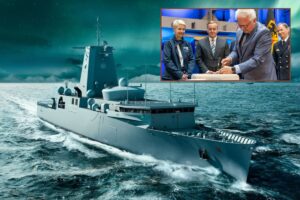
Brazil’s Tamandare-class frigate programme was described as “the most important in South America.” It is being carried out in association with German firm TKMS, but keeps to the requirement for 40% minimum domestic content.
The presentation also took in its sophisticated IPMS which enables lean crewing, and the intent to build four more frigates. Reference was also made to Brazil’d submarine programme to build, in association with France, four Scorpene-class nuclear-powered boats; delivery of the fourth sub is scheduled for 2027.
The associated nuclear programme has twin fuel cycle and propulsion system pillars. As the speaker remarked, this didn’t just mean building submarines themselves, but also the infrastructure from scratch: a construction shipyard, a maintenance yard, and a naval base.
Switching lanes and streams again, there was a fascinating presentation from Ukraine’s Snake Island Institute (SII) on lessons in asymmetric warfare from the Black Sea.
The SII functions as “a strategic bridge for defence analytics” in an environment where individual units were all doing their own R&D and development.
Ukraine had been left with no navy because when Russia annexed Crimea in 2014, seizing its main naval base, Sevastopol, and all its ships. As the speaker put it: “By all conventional measures, in 2022 Russia owned the sea.”
The presentation split the conflict since 2022 into three phases: innovation and proof of concept in late 2022; industrialisation and specialisation through 2023; and integration and swarm tactics adoption through 2024 and 2025.
A breakthrough moment had come in October 2022 with the psychological effect of drones targeting Russian vessels in their “home” port (Sevastopol) for the first time.
During phase two, Russia started relocating its most valuable warships away from Sevastopol.
There was an overview of some of Ukraine’s key USV platforms, such as the Magura V5 with its 800km range, which sank five ships and variants with integrated anti-air missiles that have downed at least two aircraft.
Phase Three saw Ukraine developing drone boats with explosive-armed uncrewed aerial systems on board from which to launch swarm attacks: “The question stopped being can Russia stop one drone, but can it stop many drones at once… the answer was usually no.”
Countermeasures developed by Russia ranged from the conventional — floating booms, nets, and jamming — to the bizarre: patrolling trained dolphins repurposed from Cold-War programmes. This was a move, the speaker claimed, that demonstrated their growing desperation.
The main lessons to be drawn, the audience heard, were:
- The efficacy of cost-exchange ratios (drones costing thousands defeating platforms costing millions);
- Tempo matters more than technology;
- Command and control distribution is highly effective;
- A fleet’s psychology is a valid target (you don’t have to sink every ship to affect a navy’s behaviour).
Finally, the electronic warfare duel was a key battleground: Ukraine lost more drones to jamming than to kinetics responses. As the speaker put it: “If you’re not thinking about EW resilience, you’re designing for the wrong threat.”
The speaker also had some advice for Taiwan in any potential upcoming conflict: scale your drone production fast, because harassment relies on mass, and don’t store all your USVs in a limited number of locations, because they’ll be vulnerable to attacks prior to being deployed.
These were just some of the lessons gleaned from a packed first day. Tomorrow will bring much more of the same!