Whether your interest lay in surface fleet or submarines, uncrewed systems or undersea warfare, future planning or operational lessons, there was plenty to keep delegates informed and engaged on Day #2 of Navy Leaders’ Combined Naval Event 2026.
There was a full day of streamed presentations stretched across no fewer than six dedicated theatres, and all of them were packed with delegates eager to glean the latest insights on current and future surface fleet capabilities, submarine operations, undersea warfare, autonomy and uncrewed systems, maritime domain awareness, AI, multi-domain operations, and so much more.
In one theatre, Fleet Commander of the Royal Norwegian Navy Commodore Kyrre Haugen gave a presentation on countering the challenges of modern navies by developing strategic partnerships.
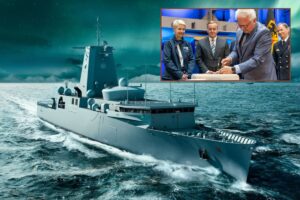
His presentation took in both the U212CD submarine programme in partnership with Germany — six boats for each nation — and the joint Type 26 frigate programme in partnership with the U.K., which will see the Royal Navy operate eight warships, and the RNN acquire five vessels.
“One of the biggest challenges for a small Navy such as Norway is that it’s very costly to keep and update systems on platforms like subs and frigates through their lifecycle,” he explained. “Strategic partnerships mean we can share those costs.”
With reference to the T26 programme, he said the ambition was that the Norwegian ships should be “99.9% identical” to their British counterparts to promote interoperability. The only points of difference would be encryption settings for national Top Secret data sets, and (he joked) perhaps power adapters!
He also said that this interoperability was driven at least part by a history of joint operations. German and Norwegian submarines have a long history of joint exercises, he said.
And in terms of surface fleet operations, he pointed to the recent Operation Highmast CSG deployment to the Far East, where a Norwegian frigate and support ship joined the U.K.-led flotilla on an eight-month visit to Japan.
During that operation a U.K helicopter had spent the entire trip embarked on the Norwegian frigate. Cdre Haugen remarked: “That is putting a strategic partnership into reality… it is how we develop that partnership together.”
He also talked about the difficulty of attracting employees into the military workforce, either as sailors or support teams, in an environment where wages in the civilian sector outstripped what the Navy could afford to pay.
But Cdre Haugen said innovations such as double-crewed ships with a 4 weeks on, 4 weeks off schedule meant the Navy could now generally offer its employees a better work-life balance, to the extent that some colleagues who had previously left the service were now returning.
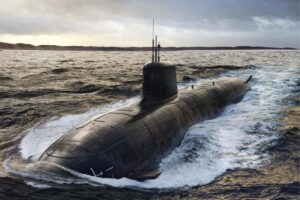
Later in another theatre there was a presentation on the French Navy’s Suffren-class submarines, taking in current progress of the construction programme, the transition from the old Rubis class to the new generation of SSNs, and remaining work on the associated infrastructure, torpedo and DDS projects.
The Suffren-class boats are a step change up in size — roughly 25 metres longer than their predecessors and at 5,300 tonnes submerged, about twice the displacement.
The new boats also feature host of new capabilities including a new optronics mast, cruise missiles, and a new Dry Deck Shelter (a removable, watertight hangar attached to the exterior of a submarine that allows special forces, combat swimmers, and submersibles to exit and re-enter while the boat is fully submerged).
Yet despite this, the speakers were keen to stress they regarded the new boats as an evolution, not a revolution, and the French Navy was keen to keep as much continuity as possible between the two classes, to help crews switch between the two types of submarines as seamlessly as possible.
The programme is progressing smoothly: three of the six boats are already operational, the fourth De Grasse, is in sea trials and the final two Rubis and Casabianca, are in the final stages of construction and are due to begin trials in 2027 and 2028, respectively.
The audience was told: “Overall the programme is meeting its main objectives. Today, our programme is increasingly focused on long-term maintenance and sustainment of the fleet… It is delivering strong operational results today; the next challenge will be to maintain this high level for the next 30 years.”
Elsewhere, the Royal Navy’s Deputy Director Underwater Battlespace Capability Commodore Marcus Rose spoke on dominance in the underwater battlespace.
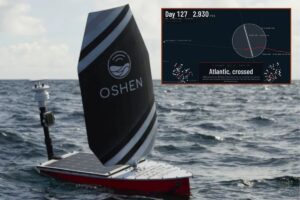
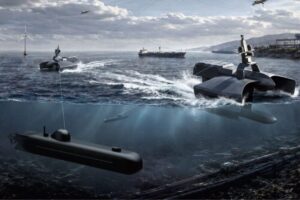
His wide-ranging presentation took in the future of RN undersea warfare, and aspects of the Hybrid Navy taking up the challenge of operations in the North Atlantic, using a mix of crewed and uncrewed systems for anti-submarine warfare (ASW).
The audience heard that while security depends on data that is routed on the seabed, dominance in the undersea domain is increasingly difficult, especially with well-publicised current platform availability challenges.
Protection of critical undersea Infrastructure (CUI) was described as “becoming the defining challenge of our time.” Delegates heard that the Atlantic had seen increased levels of submarine activity, and hostile actors willing to carry out operations “below the threshold of war.”
Against that backdrop, Atlantic Bastion represents the U.K.’s first line of defence; Cdre Rose characterised it as “an ambitious but achievable plan to expand the capabilities we have today.”
Its first line of effort, Atlantic Net, seeks to integrate commercial industry partners to deliver ASW sensing as a service. While Cdre Rose declined to go into too many details because of an ongoing tender process, he revealed a capability would be in the water before the end of the calendar year.
“Time is the driving factor in this process,” he admitted, adding: “We are very close to down-selecting a partner.”
He also said the lethality offered by crewed assets, in particular Type 26 frigates and submarines, also had a key part to play, because “deterrence requires credible combat power.”
And he concluded: “We cannot do this alone… We need to find ways to go further and faster with industry… sharing problem sets at the right levels of classification.”
A later presentation took in the U.K. Commando Forces and enabling strike and advantage in the High North.
The audience was given a high-level overview of the RN was organising and fighting in a much more contested environment characterised by persistent competition, and accelerated change, and where advantage was transient rather than enduring, and success depended on the ability to integrate and adapt faster than your opponent.
In this context, the audience heard, the Hybrid Navy concept was misunderstood if regarded as an acquisition programme; it was better characterised “as a way of fighting and organising.”
For the Commando Force, the key parts to the HN are that people, not assets remain decisive; that crewed and uncrewed elements were entirely complementary; and that integration created advantage.
Drawn from all military domains, the Commando Force, the audience heard, represented “the landward extension of fleet lethality… It is not simply a ‘Break Glass’ single-use capability… but a persistent, forward-deployed leading edge of the fighting force.”
The other key thing to remember was that in the High North, the environment itself remained a determining factor that dictated tempo and what was possible. As one of the two speakers succinctly summarised: “The environment is trying to kill you before you even see the adversary.”
And asked whether plans to draw all special forces into a common command structure should be viewed as a help or hindrance, the reply was equally no-nonsense: “We should spend less time worrying about who works for whom, and more time figuring out how to fight.”
The speaker did acknowledge, though, that anything which helped avoid duplication of effort across disciplines should be viewed as a step forward.
One afternoon “fireside chat” presentation focused on operational and industrial lessons learnt from the German-Norwegian Type 212CD submarine programme.
It was jointly conducted by Captain Jim Robertsen, Head of the Royal Norwegian Navy’s Submarine Service, and Commander 1st Submarine Squadron of the German Navy, Commander SG Kai Nickelsdorf.
The collaborative programme, which arose from a 2017 decision by the Norwegian Government to procure the Type 212CD, arguably originally had its roots in the history of joint torpedo firing exercises between the two submarine forces which stretched back as far as 1994, the audience learned.
The collaboration actually stretches beyond just the submarine programme: the two nations are also working together on integrated air and missile defence, the Naval Strike Missile (NSM), ASW capabilities and naval mine warfare.
In terms of the submarines themselves, each nation is procuring six Type 212CD platforms each; the first in class will be a Norwegian boat set to be delivered in 2029.
The boats of both nations are set to be configured for both submarine-launched NSMs and the IDAS air defence missile being developed by German Navy.
As Cdr Nickelsdorf observed: “It’s not just a cooperation; in a few years it will be in part a common submarine force.” This was evidenced in part by the way the two navies are intending to follow a common crewing concept in the years ahead.
In another theatre delegates got a whistle-stop tour of the Royal New Zealand Navy’s Fleet Renewal Programme from its Co-Director Maritime Fleet Renewal, Commodore Brendon Clark.
This will be, he made clear, the largest single transformation ever taken on by the New Zealand Defence Force. It will look to include a rationalisation and simplification of the RNZN fleet structure: at present its eight ships comprise no fewer than five different classes.
A deliberately phased introduction into the 2030s will enable the RNZN to adopt a series of uncrewed technologies as part of the strategy. And one of the main decisions will be which platform to select to replace its ageing Anzac-class frigates.
British Type 31s and the Japanese Upgraded Mogamis just picked by the Royal Australian Navy are the two shortlisted contenders; a recommendation as to which will be made to the NZ Government by the end of 2027.
Mention was made, too, of the Maritime Helicopter Replacement Programme; the RNZN is replacing its secondhand and ageing Sea Sprite helicopters with MH-60s.
And efforts are being made to shore up its logistic supply chains after COVID-19 and the Ukraine conflict highlighted potential weaknesses.
There was so much to take in today… this already over-long summary hasn’t had time to reference fascinating presentations on — to cite three examples at random — the ROK Navy Sea Ghost Programme; the British perspective on homeland defence as an island nation; and naval developments in Russia.
We can only recommend you download our post-event Insights report when it appears in a few weeks time. And, even better, make sure you’re attending these events in person! And in the meantime, look out for our Day #3 summary, appearing on this website tomorrow afternoon.