
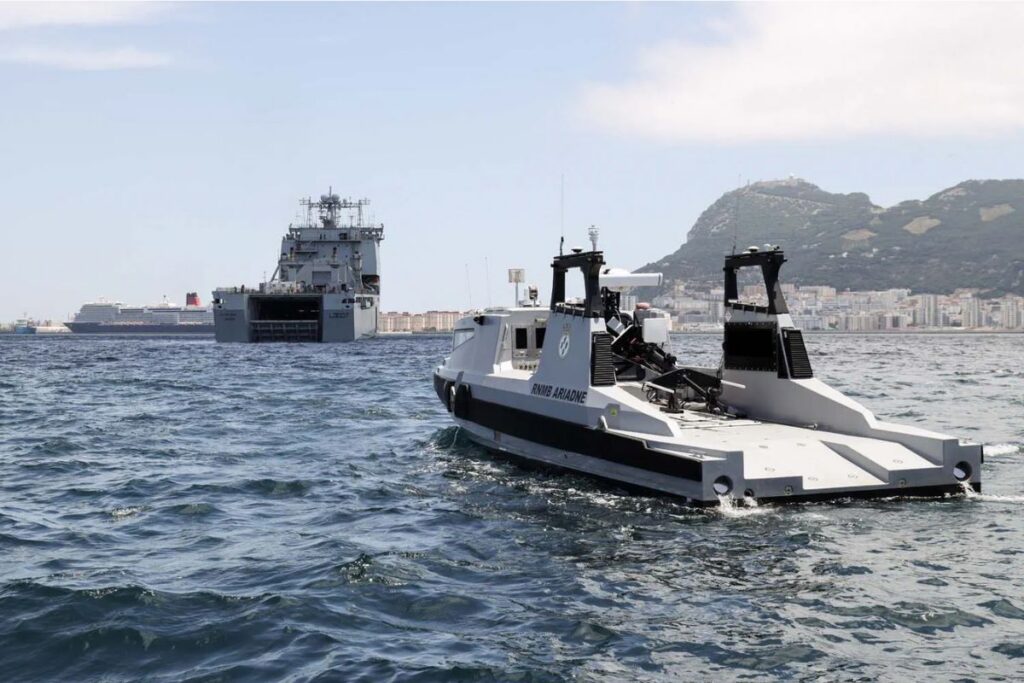
Royal Fleet Auxiliary ship RFA Lyme Bay is readying herself off Gibraltar ahead of a possible Royal Navy minehunting mission in the Strait of Hormuz.
The Bay-class auxiliary dock landing ship has spent the last few weeks docked at the British naval base at the entrance to the Mediterranean being equipped as a minehunting mothership.
She is set to play a central role in a multinational effort to secure the critical waterway and ensure freedom of navigation for commercial shipping — if and when a lasting cessation to hostilities is agreed between America and Iran.
Should Operation Epic Fury, the U.S. and Israeli offensive against Iran, be brought to an enduring conclusion, an Anglo-French-led mission involving over 40 nations could be mounted to secure freedom of navigation in the Strait of Hormuz.
Royal Navy Type 45 destroyer HMS Dragon will have a significant role, having been deployed east of the Suez Canal earlier this month.
Other British vessels earmarked to take part will include autonomous mine hunting and disposal systems, and uncrewed surface vessels (USVs) acquired under Project Beehive.
The assets include the second uncrewed minehunter delivered under the Maritime Mine Counter Measures (MMCM) programme. The suite consists of a 12-metre uncrewed surface vessel (USV) — RNMB Ariadne — a Towed Synthetic Aperture Multiviews (TSAM) sonar, a Remotely Operated Vehicle (ROV), and a portable operations centre (e-POC).
Other kit on board includes a USV which can deploy Seacat, an autonomous underwater vehicle (AUV) that can produce 2D and 3D sonar scans of the seabed, and another Remus surveying UUV.
Also set to be deployed are the RN’s first K3 Scouts USVs supplied by Kraken Technology Group under Project Beehive, which are capable of 55 knots and suitable for both strike and ISR missions.
As per RN press statements, RFA Lyme Bay has now departed Gibraltar with its array of minehunting kit embarked, as well as more than 100 expert minehunting personnel from the Royal Navy’s Diving and Threat Exploitation Group (DTXG) and Mine and Threat Exploitation Group (MTXG).
Commander Dan Herridge, Commanding Officer of MTXG, said: “Personnel from MTXG will embark in RFA Lyme Bay with a clear purpose: to deliver a credible, modern Mine Countermeasures capability.
“Enabled by the Minehunting Capability Programme, they will employ cutting-edge sensors delivered through autonomy and AI to detect threats to the maritime community in some of the world’s most challenging environments.
“Working closely with specialists from DTXG, these threats will be neutralised.”
RNMB Ariadne was successfully manoeuvred into the floodable dock of RFA Lyme Bay off Gibraltar earlier this week, having been transported to Gibraltar from the U.K. on HMS Stirling Castle.
Lieutenant Commander Craig Wadley, operations officer with Commander UK Mine Counter Measures Force, said: “This was a successful first day of operations and great to see the integration of Ariadne with Lyme Bay.”
- You can read more details on the Royal Navy website