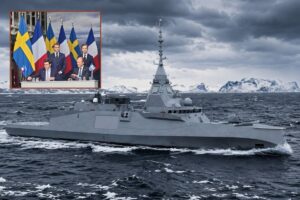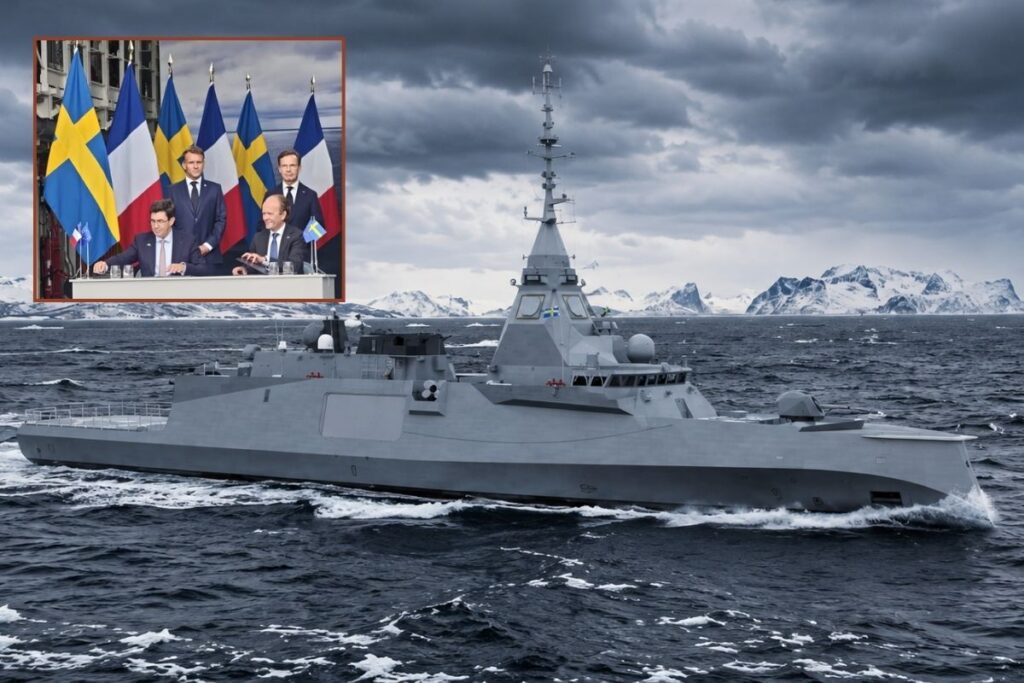
Sweden’s Defence Materiel Administration (FMV) has signed the contract with Naval Group to procure four FDI frigates for the Royal Swedish Navy.
The first of the four Swedish Frégates de Défense et d’Intervention (Defence and Intervention Frigates, or FDIs) is scheduled to be delivered in 2030. If all goes to plan first-in-class HMS Lulea will be followed by HMS Norrkoping in 2032, HMS Trelleborg the following year, and HMS Halmstad in 2034.
The deal was signed yesterday (Monday) in the presence of French President Emmanuel Macron and Ulf Kristersson, Prime Minister of Sweden.
Mikael Granholm, Director-General of the FMV and Pierre Éric Pommellet, Chairman and CEO of Naval Group, put pen to paper for the deal, concluding four months of detailed negotiations after Sweden chose the FDI design.
Mr Pommellet called the agreement “a major milestone in the cooperation between our two countries.” He added: “It is an honour to put our expertise at the service of the Swedish Royal Navy’s sovereignty and naval superiority, and I would like to thank the Swedish authorities for their trust. Naval Group is already fully involved and committed to the delivery of this major project.”
Mr Granholm added: “This is a big day for FMV and for the Navy. FMV is now signing contracts for four very advanced ships that will strengthen both our own and NATO’s overall defence capability.”
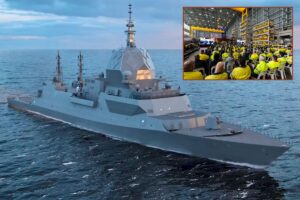
The FDIs are multipurpose warships with a range of air defence, anti-submarine warfare, anti-ship and asymmetric warfare capabilities. Each ship is 122m long, displaces just under 4,500 tonnes, and is capable of a maximum speed of about 27 knots.
In their base configuration FDIs have a range of about 5,000 nautical miles and are armed with Exocet anti-ship missiles and Aster 15 or 30 and MIstral-Simbad surface-to-air missiles, as well as MU90 torpedoes.
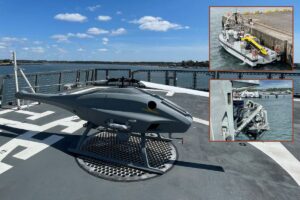
They can embark either NH90 or H160M helicopters as well as a rotary-wing Airbus VSR700 uncrewed aerial system (UAS).
The Swedish ships will have the Aster 30 and CAMM-ER missiles and will also be equipped with several Swedish systems, including Saab Bofors Dynamics’ long-range “fire-and-forget” anti-ship and surface-to-surface missile RBS15, Saab’s Torpedo 47 lightweight torpedoes and Giraffe 1X radar, and its Trackfire remote weapon station (RWS).
As well as France, the Hellenic Navy also operates the warships; they are a more heavily armed version of the original FDI vessels conceived as a new class of “first rank” French frigates (the French Navy does not use the term ‘destroyer’).
In the Greek FDI programme, first-in-class HS Kimon was delivered in December 2025. The second warship, HS Nearchos, has also been launched; she is scheduled for delivery next month. Both are expected to be commissioned by mid-2027.
HS Formion is scheduled for delivery in late 2026, and in November last year it was announced that the Hellenic Navy would acquire a fourth FDI warship, as well as securing a series of additional capability upgrades across the other three vessels. HS Themistocles is due to be handed over in 2028.
Five FDIs have been ordered for the French Navy; the first-in-class, Amiral Ronarc’h, was delivered in October 2025 and is currently undergoing the usual extensive French post-acceptance sea trials; she is expected to be officially commissioned this year.
Amiral Louzeau, Amiral Castex, Amiral Nomy will follow from 2027, as well as the fifth vessel Amiral Cabanier. She was ordered at the end of March this year, and is projected for delivery in 2032.
- You can read more details about the Swedish contract on the Naval Group website