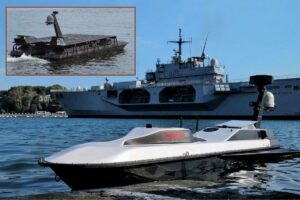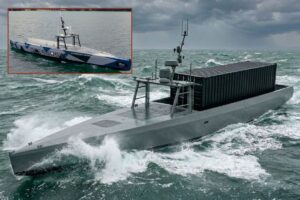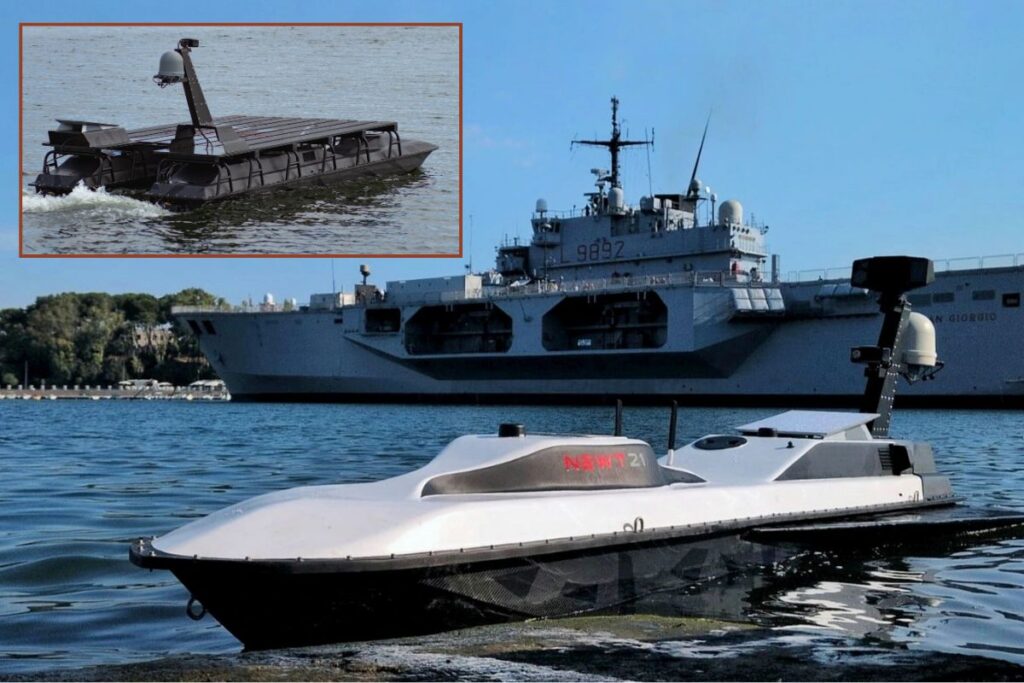
Latvian drone boat builder NEWT21 is seeking commercial orders for its two USV platforms, which are now fully qualified and production-ready.
The Riga-based technology firm said its FOG and RAY uncrewed surface vessels (USVs) were now at Technology Readiness Level 8 (TRL 8): in other words, complete and fully qualified through tests and demonstrations.
Co-funded by the European Union via its European Regional Development Fund, the firm has been testing its platforms on various multinational stages including NATO’s Steadfast Dart and the recent Task Force X-Central Mediterranean exercise in Puglia, Italy.
Its FOG USV has been optimised for high-speed stealth reconnaissance, patrol, interception, and strike operations. It’s capable of up to 46 knots, has a maximum payload of 200kg, and a range of almost 500 nautical miles.
The larger RAY USV is a catamaran designed for logistics, surveillance, and hydrographic missions. It has a 500kg payload capacity, a top speed of 42 knots, and a range of almost 400nm at a 27-knot cruising speed.
It can act as a drone mothership for uncrewed aerial systems (UAS) and has reportedly seen live operational use in Ukraine.
Both platforms are built from carbon fibre and Kevlar. They feature both GNSS and INS navigation systems, integrated satellite communications, and are swarm-enabled, with one controller able to operate up to 32 drones at the same time.
As per a company statement at the Italian trials: “We have shifted operations from the Baltic to southern Italy, successfully integrating the USV FOG into a wider C3 architecture.
“Alongside forces from the United States, Italy, Latvia, Slovenia, and Croatia, we are demonstrating full mission capability among 100+ uncrewed air, surface, subsurface, and ground systems. Our focus is on intelligence, surveillance, reconnaissance, crewed-uncrewed teaming, and interoperable command and control — turning these capabilities into solutions that can be adopted and scaled at speed.”
- You can read more details on the NEWT21 website and on its social media feed