
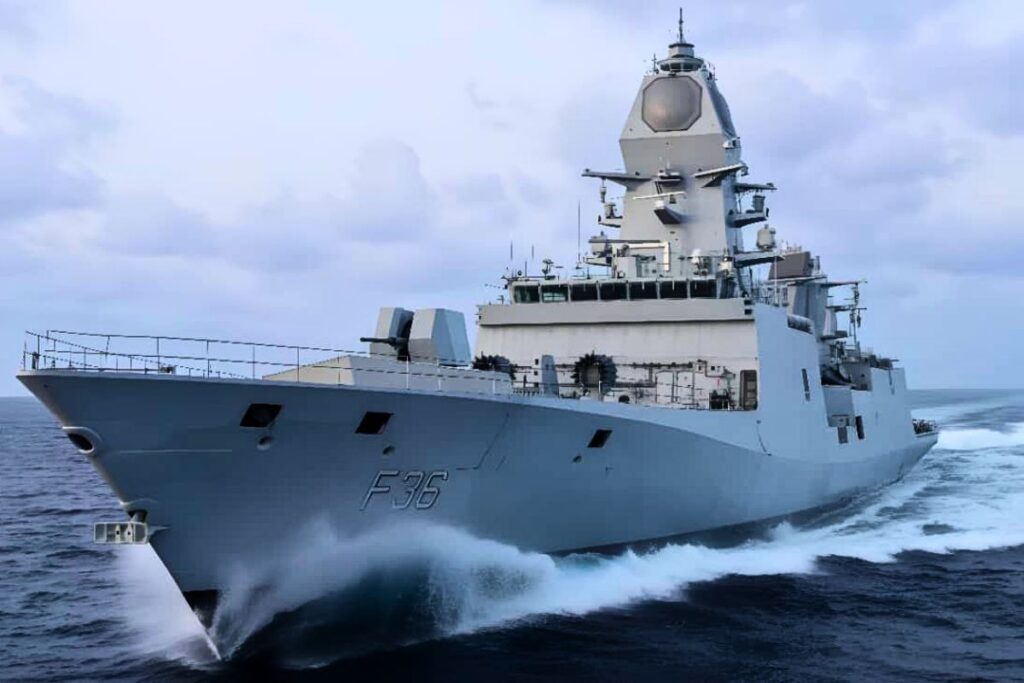
Garden Reach Shipbuilders and Engineers Ltd (GRSE) has handed over three new ships to the Indian Navy including new stealth frigate INS Dunagiri.
The fifth Nilgiri-class warship, also referred to as Project 17A vessels, is the second ship in the class built by the Kolkata-based shipyard.
The other two ships delivered by GRSE across a busy two-day period were INS Agray, the fourth of eight ASW SWC (Anti-Submarine Warfare Shallow Water Craft) being built by the shipyard, and INS Sanshodhak, the last of four Large Survey Vessels.
INS Dunagiri is the latest Nilgiri-class frigate, which are replacing the Shivalik-class vessels. As per the Indian Ministry of Defence (IMoD), the 149-metre warships “represent a generational leap” from their predecessors.
Roughly 75% of all the ship’s systems have been domestically developed. They displace about 6,700 tons, have a 5,500-nautical-mile range and are capable of cruising at up to 32 knots.
Each warship’s weapon suite includes the supersonic BrahMos anti-ship missile system, and Barak 8 medium-range surface-to-air missiles. The ships are also fitted with Varunastra torpedoes and an OTO Melara 76mm naval gun, and a combination of 30mm and 12.7mm rapid-fire close-in weapon systems.
INS Agray is the latest of 16 domestically-built new anti-submarine warfare (ASW) corvettes produced.
Eight vessels each are being built by GRSE and Cochin Shipyard (CSL) and all 16 ships are scheduled to be delivered by the middle of 2028.
The littoral vessels displace about 1,500 tonnes, and are powered by a diesel-driven waterjet which gives them a maximum speed of about 25 knots.
They are designed to carry out a broad range of ASW and other operations including underwater surveillance, search-and-destroy missions and coordinated ASW missions in tandem with naval aircraft.n They also have air defence, mine-laying, and search-and-rescue (SAR) capabilities.
INS Sanshodhak, the Indian Navy’s final Large Survey Vessel (SVL), is built for coastal and deep-water hydrographic surveys.
The 110-metre ship, which displaces about 3,400 tons, will be used to examine port and harbour approaches, determine navigational channels, and collect oceanographic and geophysical data for defence and civil applications.
- You can read more details on the Indian Ministry of Defence website