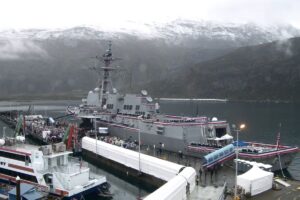
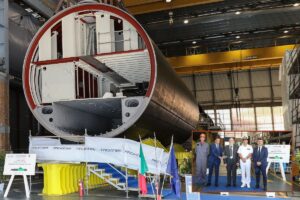
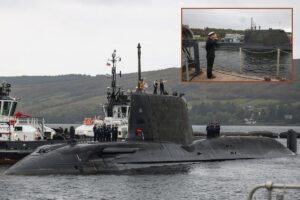
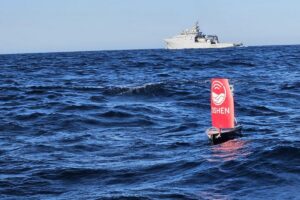
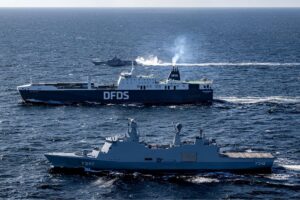
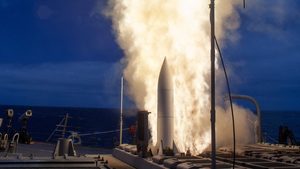
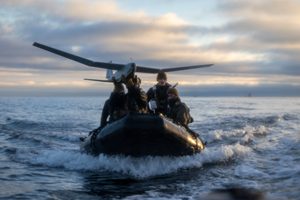
For the last month navies and industry partners have been working side by side in Portugal at REPMUS, the world’s largest annual maritime robotics exercise.
Hosted by the Portuguese Navy, this year marks the 16th iteration of REPMUS — Robotic Experimentation and Prototyping using Maritime Unmanned Systems.
The operational exercise (OPEX) is dedicated to testing and integrating uncrewed maritime systems into the wider defence ecosphere.
For the last two days Navy Leaders has been spending time at the experimentation site on the Troia peninsula south of Lisbon, witnessing and getting briefed about some of the chief developments at this year’s exercises.
This year’s serials have involved more than 1,500 people from 36 navies, in excess of 60 industry partners, 13 universities, five NATO organisations, more than 300 uncrewed maritime systems and at least 14 naval vessels. They started at the end of August and conclude on Friday.
This year one of the main focuses has included an expansion of the work being carried out by Task Force X-Arctic, an initiative spearheaded by NATO Allied Command Transformation (ACT).
NATO’s STO Centre for Maritime Research and Experimentation (CMRE) has been overseeing implementation and testing of a scaled-up version of the command-and-control system connecting crewed and uncrewed assets first trialled in Iceland in June and July.
At REPMUS 26 this new digital backbone connecting crewed and uncrewed assets across air, surface and underwater domains — enabling automatic detection, target tracking and retasking of assets — has been tested on a much bigger canvas.
A TFX-Arctic source explained: “It’s not just suitable for the Arctic; the system itself can be used wherever you want… from Day Zero integrating different assets and providing persistent, wide-area awareness.”
The TFX-Arctic approach is taking a truly-data-centric model underpinned by the shared NATO STANAG 4817 communication protocols to close the loop between data-gathering and decision-making.
The common operational picture (COP) produced is enhanced by AI algorithms being developed to analyse mission objectives, data inputs, platform constraints and the operational environment, and present suggested courses of action retasking assets to mission commanders.
Lessons gleaned at REPMUS 26 will directly inform the planning for the next steps on the TFX-Arctic roadmap, which will see a return to Arctic environments with more OPEX testing in Tromso, Norway, in November. Further out, the team is targeting a wider capability demonstration in summer 2027.
Among the many briefings given to Navy Leaders over the past two days on technologies and systems being tested, developed and integrated at REPMUS were the following:
- Kelluu’s airships providing persistent ISR capabilities, with details of its TFX-Arctic tasking, company growth, new factories and next-generation airships in development;
- Marble’s UAS offering low-cost, long endurance ISR from automated hangars in austere environments;
- Tekever’s integration of sonobuoy deployment from its UAS platforms and planned at-sea landing demonstration on a Royal Navy aircraft carrier;
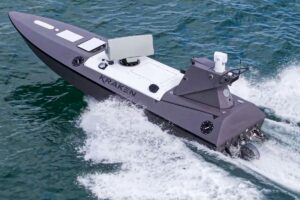
- Stark’s rapid development of its existing and forthcoming new larger armed USV platforms;
- Aureus’s edge-processed video data analysis capabilities;
- Beechat’s system offering widespread distributed encrypted communications via a datamesh network;
- Hefring’s IMAS predictive AI system to avoid excessive impact stresses on USVs, and its ODIN network that takes civilian vessel radar inputs and compares AIS signals to flag anomalies.
Expect to read further reports from Navy Leaders with more details about these firms and others, their systems and their work conducted at REPMUS 26 in the weeks ahead.
The Navy Operational Experimentation Centre (CEOM) is the central facility hosting and organizing REPMUS 26 across its twin centres in Troia and Sesimbra.
Its Director, Portuguese Navy Captain Caldeira De Carvalho said one of the notable features this year had been the Nordic nations and Ukrainian representatives combining to form the “Red Team” for operational exercises, helping allies to develop new tactical doctrines.
And he also highlighted the increasingly central role that AI was playing in all aspects of the serials. He suggested the correct course of action was a balanced approach: “A serious recognition of the dangers, but we cannot ignore it, because if we do not use it, our adversaries will.”