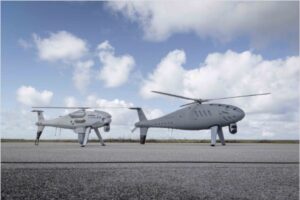
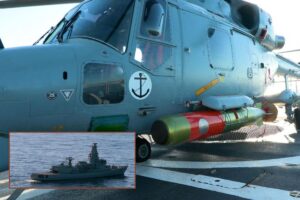
The Royal Navy’s Wildcat maritime attack helicopters can now carry Sea Venom anti-ship missiles on front-line duties after the system reached Initial Operating Capability (IOC).
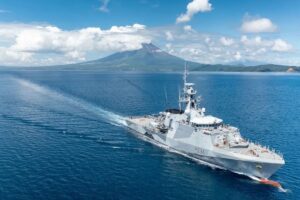
As per a recent press statement, the milestone was reached during Operation Highmast, an eight-month Carrier Strike Group (CSG) mission to the Indo-Pacific led by RN flagship HMS Prince of Wales.
Four Wildcats from 815 Naval Air Squadron are armed with Sea Venom on the Operation Highmast deployment; they are embarked upon Norwegian frigate HNoMS Roald Amundsen, aircraft carrier HMS Prince of Wales, and destroyer HMS Dauntless.
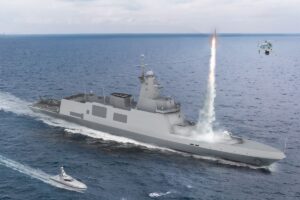
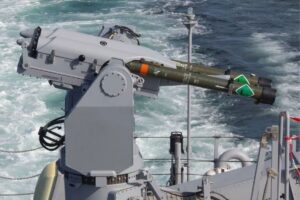
Each Wildcat helicopter is able to carry up to four Sea Venom missiles; they are manufactured by MBDA, fly at close to the speed of sound, and have a range of over 11 nautical miles.
Optimised against large coastal patrol vessels and corvettes, the missiles can also be used against land-based coastal installations and inland targets as required. Once fired, the trajectory of the projectile can be adjusted mid-flight if needed.
Commanding Officer of 815 Naval Air Squadron, Commander James Woods, described the missile as a “transformational capability for the Fleet Air Arm” and went on to note: “The introduction of Sea Venom is a step-change in our combat power.
“It delivers a lethal combination of precision, reach, and flexibility that allows us to strike decisively against a wide spectrum of threats in the maritime, coastal, and land domains. Most importantly, it gives us the ability to neutralise those threats at range.”
- You can read more details on the Royal Navy website