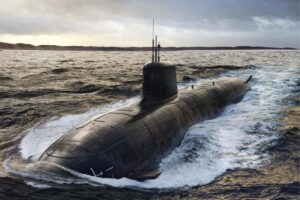
Australia will now acquire three in-service Virginia-class submarines instead of two, plus one new boat under revised AUKUS Pillar I plans, the tri-nation alliance has agreed.
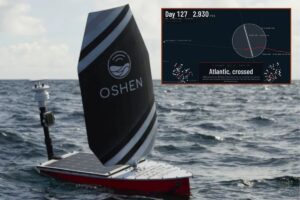
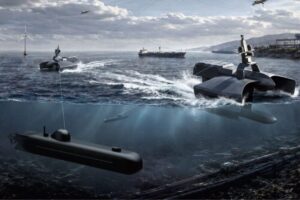
And the three nations have also announced joint development of sensor and weapon payloads to be deployed from uncrewed underwater vessels (UUVs) under Pillar II of the project, with the first capabilities expected to be in service as soon as next year.
Both announcements were made at the weekend following a meeting in Singapore between U.K. Defence Secretary John Healey, U..S Secretary of War Pete Hegseth and Australian Deputy Prime Minister Richard Marles.
Under AUKUS, Pillar I centres on Australia’s acquisition of conventionally armed, nuclear-powered submarines, while Pillar II seeks cooperation to develop new common military capabilities.
Prior to the latest announcement, under Pillar I Australia had been expected to acquire a brand-new Virginia-class submarine from the U.S. alongside two second-hand boats prior to the nation building its own SSN-AUKUS nuclear-powered subs in the 2040s.
Mr Marles characterised the new decision not to buy any new Virginia-class boats as placing “a premium on simplicity” although he also acknowledged there would be cost savings to this approach, too.
He commented: “It will mean that the Virginia-class submarines that we are acquiring will all be of the same type… And I cannot overstate the significance of that, both in terms of the submariners who are operating them, but also the people who are working on them to sustain those submarines. Chasing simplicity is at the heart of why we have pursued this.”
Another potential reason suggested by commentators is the revised plan helps ease pressure on the U.S. industrial base, which is struggling to build new boats at the speed required to both supply American domestic requirements and fulfill AUKUS obligations.
Under the revised schedule the first Virginia-class boat is due to be transferred to Australia in 2032, with another arriving every four years, before the Australian-built model is ready for operations towards the start of the following decade.
The other part of the weekend’s announcement centred on Pillar II and the three nations’ planned collaboration on UUV payloads.
The ministers characterised the new push as the AUKUS partners ‘stepping on the accelerator’ to develop, produce and deploy cutting-edge technologies.
A U.K. Government statement noted: “This work will support the development of payloads, such as sensors and weapons systems, that can be deployed across all three nations’ UUV fleets, increasing collective strength and deterrence across the Indo-Pacific and Euro-Atlantic.”
It added: “The first capabilities are expected to be in service by 2027 and will help drive the Royal Navy’s transition to a Hybrid Navy — a more flexible, modern force that blends crewed and uncrewed platforms.
“The payloads will allow the Royal Navy to detect underwater threats to the UK and allies’ critical undersea infrastructure. The Royal Navy will be able to integrate payloads from the US and Australia, meaning a more effective and lethal force. The tech will be used to reinforce the future SSN-AUKUS attack submarine fleet.”
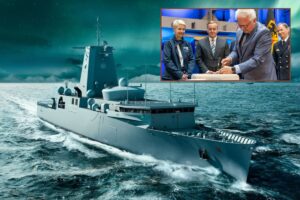
Mr Healey also announced the four winners of the 2025 AUKUS Maritime Innovation Challenge, including three U.K.-based suppliers.
The firms are developing systems enabling command, control and teaming of UUVs; each company will receive a share of £3 million to refine and test capabilities.
The U.K. winners are Basingstoke SME Decision Analysis Services Ltd; Frome-based SEA Ltd; and Dorchester-based A-2i. The fourth winner was a U.S. firm, Boston-based MSI Transducers.
- You can read more details on the U.K. Government website and the Defence Australia website