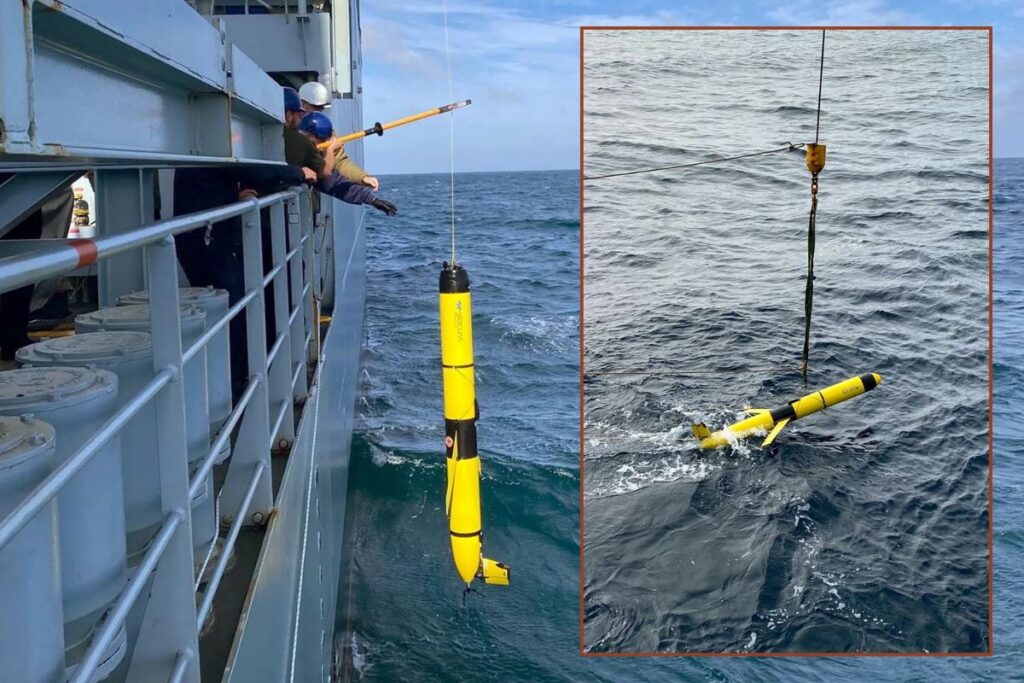
Working towards Atlantic Bastion and its Hybrid Navy vision, the Royal Navy has been deploying underwater gliders in the waters off the U.K.
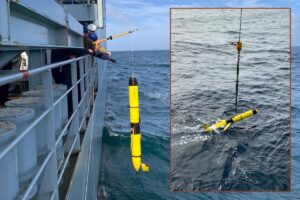
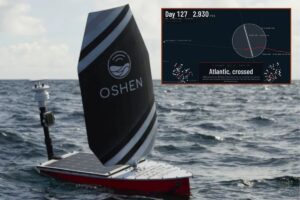
It said five Teledyne Marine Slocum G3 gliders had spent 64 days at sea gathering and transmitting oceanographic data. The uncrewed underwater vehicles (UUVs) glide through the water at varying depths and periodically surface to send data.
The two-month trials represent work towards establishing a permanent persistent sensing network, part of the service’s Atlantic Bastion initiative to establish improved situational awareness and enhanced Anti-Submarine Warfare (ASW) capabilities in the North Atlantic and beyond.
The data-gathering mission was run out of HMNB Devonport by the RN’s Meteorological and Oceanographic (METOC) Information Warfare Group (MIWG).
Download our free feature produced with Teledyne Marine: Sensor Sensibilities: Building Blocks For A Hybrid Navy
As per a press statement, the group used five of the Teledyne gliders in combination with Apex floats — autonomous, ship-free drifting profiling floats which sink and rise through water columns in cycles and transmit data via satellite links.
The two systems were recording information including conductivity, temperature and depth to calculate water salinity fluorescence levels — all key information needed to help navies see and identify what’s under the waves.
The RN statement read: “The gliders represent a key component of the Future Military Data Gathering Programme, a Navy Develop initiative designed to transition meteorological and oceanographic data collection from traditional crewed platforms to a distributed network of autonomous systems and specialised deployable teams.”
Commanding Officer of MIWG and Head of Information Warfare METOC Commander Neil Masson said: “This deployment proves that autonomous systems are now part of how the Royal Navy gathers environmental intelligence.
“MIWG has delivered persistent oceanographic collection at scale, improving our understanding of the underwater environment and giving commanders the information they need to gain warfighting advantage. I am extremely proud of the team, whose professionalism and determination have taken this capability from development into sustained operation for the Royal Navy and wider defence.”
Executive Vice President at Teledyne Marine Brian Maguire added: “Sixty-four days at sea with no crew on the water. This creates a real advantage in the undersea domain. Being there continuously, without committing ships is a force multiplier. We’re proud to be part of the UKRN’s Hybrid Navy mission set.”
The RN revealed that in 2024 and 2025 alone, autonomous oceanographic systems had generated more than 193,000 observations, equivalent to over half the total number collected through traditional methods during the previous 77 years.
- You can read more details on the Royal Navy website