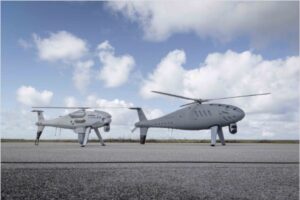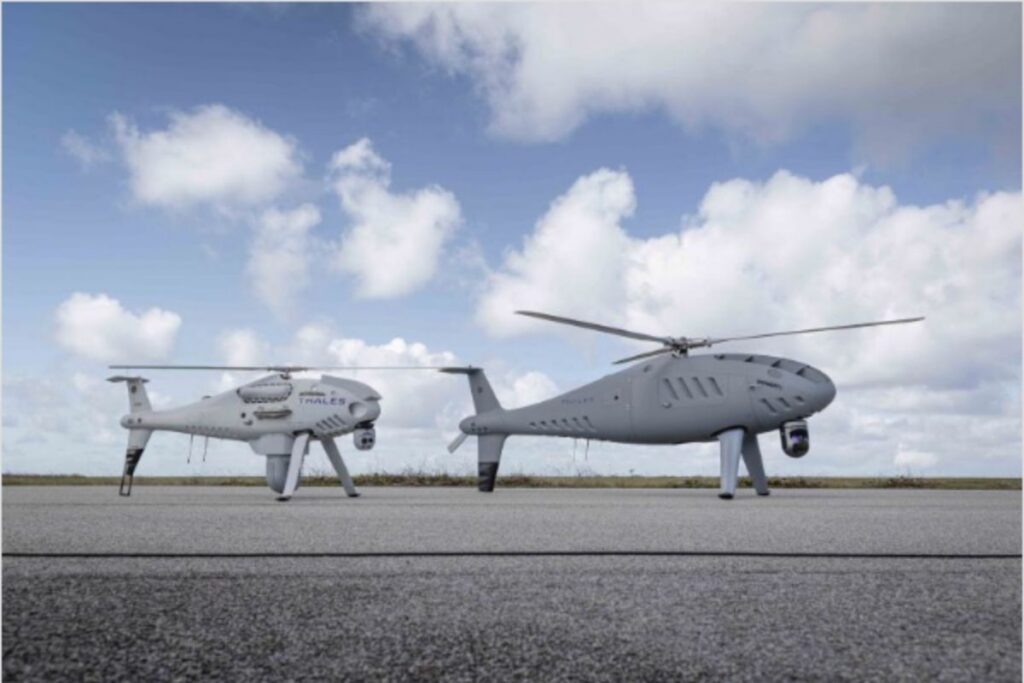
Schiebel’s Camcopter S-300 uncrewed aerial system (UAS) took to the skies in the U.K. for the first time as part of a capability demonstration for the British Army and Royal Navy.
As per statements from Schiebel and sensor partner Thales, the new platform recently made its U.K. debut as part of an exclusive live demonstration staged for both Army and Navy representatives showcasing technologies relevant to the Royal Navy’s uncrewed aviation programmes such as Peregrine, and the British Army’s Land Autonomous Collaborative Platform (Land ACP).
The heavy-lift vertical take-off and landing (VTOL) S-300 is a larger, more powerful successor to the S-100 already utilised by both forces, as well as many other military allies. It offers three times the payload capacity and significantly extended flight endurance.
With a 50kg payload the new version of the UAS can remain airborne for up to 24 hours at a time; it has a maximum payload capacity of up to 350kg (including fuel).
As per Thales: “The demonstration highlighted how rapidly evolving autonomous technologies can enhance mission capabilities and enable greater flexibility for armed forces in complex operational environments.
“The deployment of the S-300 demonstrated how a modern uncrewed VTOL platform can be combined with advanced sensors, autonomy and mission systems to deliver capability across land and maritime environments.”
And Schiebel added: “During a live capability demonstration for representatives of the British Army and Royal Navy, the Camcopter S-300 successfully completed its first U.K. flight demonstration.
“Together with Thales, Schiebel showcased the evolving capabilities of autonomous systems and crewed-uncrewed teaming.”
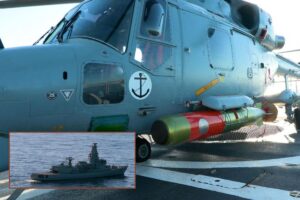
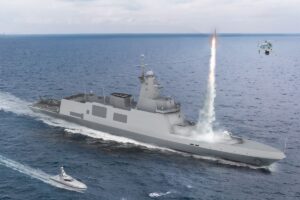
In a naval context the S-300’s primary design focus is Anti-Submarine Warfare (ASW) and advanced surface target detection; it has been selected as the airborne element of Europe’s SWORD project, led by TKMS Atlas Elektronik.
Financed by the European Defence Fund, the 36-month SWORD (Stand-off anti-submarine Warfare Operations by Remote Deployment) programme which started in 2025 seeks to build an integrated “sensor-to-shooter” network designed to remotely track and neutralise submerged threats from distance.
- You can read more details about the new UAS on the Thales website and the Schiebel website