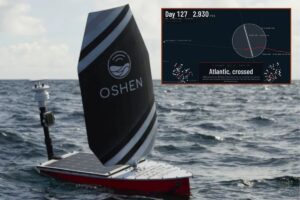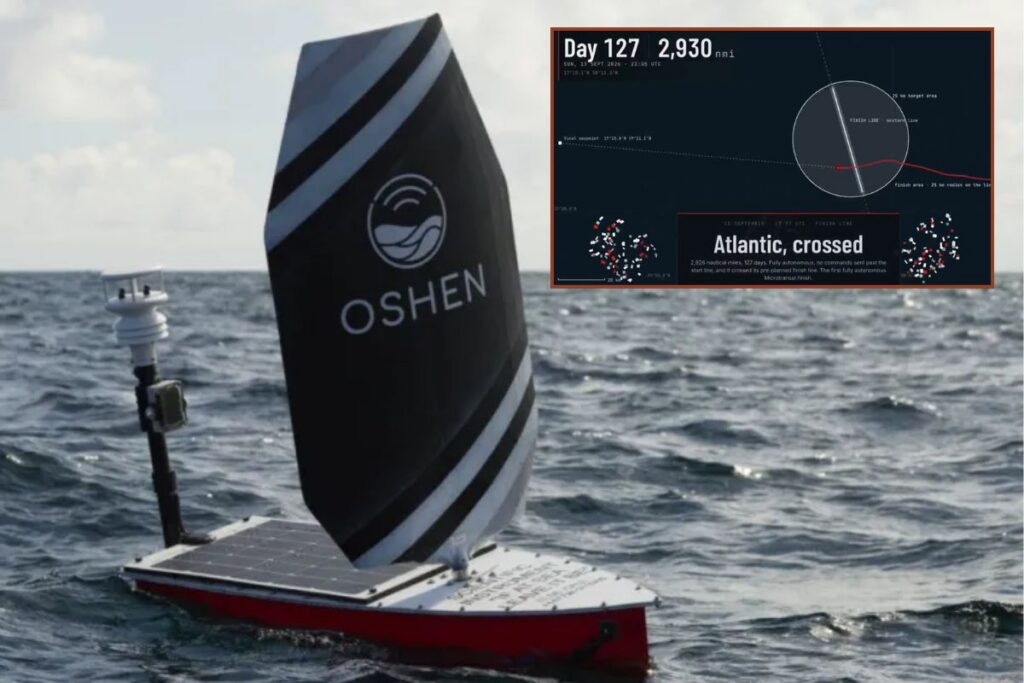
Oshen’s C-Star small uncrewed surface vessel (USV) has become the first drone of its kind to complete an autonomous transatlantic crossing.
The C-Star is a 1.2-metre micro-USV designed for long-endurance ocean sensing. It is built to operate in low-cost, mass-deployable constellations that function as a wide-area sensor network.
Primarily wind-powered, the drone has integrated solar panels charging internal batteries and can also alter position via electric thrusters.
Oshen this week revealed that one of its C-Star drones had become the first platform to complete the Microtransat challenge, a competition for uncrewed vessels under 2.5m to autonomously navigate across the Atlantic Ocean.
Hand-launched from a rhib off the coast of Gran Canaria in the Canary Islands on May 9, the drone was set the target of sailing to a point described by a 25km circle almost 2,500 miles distant, just off the coast of Barbados.
From May 19 onwards — just before the USV crossed the start line — no further commands were sent to the drone, which sent data back every ten minutes throughout its transit. It crossed the finish line on September 13, after a 2,926-nautical-mile, 127-day transit.
As per a social media statement, Oshen noted: “The allure of the Microtransat challenge… that since founding in 2006 had never seen a successful attempt in the autonomous category, is what first got Anahita and Ciaran hooked on the technology that led to Oshen.
“After two previous failed attempts and some engineering efforts, the C-Star crossed the finish line on Sunday morning.”
Anahita Laverack and Ciaran Dowds are the co-founders of the Plymouth-based start-up. In August it was revealed that ZeroUSV’s 12-metre USV Oceanus12 had autonomously deployed C-Star drones as part of a technology trial.
- You can read more details on Oshen’s LinkedIn page