
The Royal Navy’s Atlantic Bastion undersea sensing and security programme has taken a leap forward via a new deal with Teledyne Marine for uncrewed underwater vehicles (UUVs) and sensors.
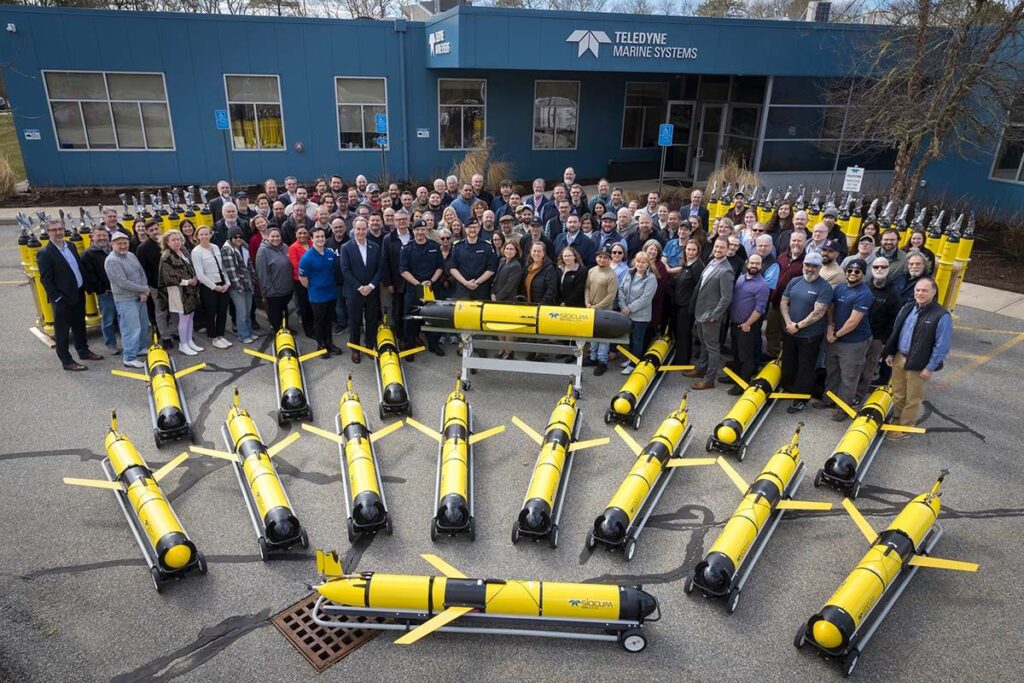
Under the terms of the newly agreed contract the defence firm, the marine arm of Teledyne Technologies, will supply Britain with Sentinel and Slocum UUV gliders, autonomous Gavia AUVs, and APEX floats.
The deal agreed between the firm and the U.K. Ministry of Defence will enable the RN to boost its ocean data collection and surveying capabilities.
Change detection is a key element in any persistent surveillance system and these sensors will help to build a picture of what “normal” looks like under the waves.
As per an RN press statement, the new kit will be deployed with its Information Warfare meteorological and oceanographic (IW METOC) operators under the RN’s Future Maritime Data Gathering scheme. The RN has been using Teledyne’s Slocum gliders in a more limited capacity since 2015.
The RN statement noted: “Together, this equipment will support operational planning, maritime safety, and defence activities, directly supporting Atlantic Bastion.”
Navy Develop Commander Mark Butcher commented: “This investment in autonomous ocean sensing strengthens the Royal Navy’s ability to understand and operate in an increasingly contested North Atlantic, supporting Atlantic Bastion.”
He added: “Persistent data from systems such as these enhances our understanding of the underwater battlespace, enabling tactical exploitation of the environment and delivering the operational and information advantage commanders need.”
President and CEO of Teledyne George Bobb added: “This award reflects the Royal Navy’s continued confidence in Teledyne’s autonomous underwater vehicles and ocean observing technologies, and our established partnership in delivering proven, mission-ready solutions.”
Teledyne’s Gavia AUV family includes SeaRaptor drones rated at depths of up to 6,000m, while its Slocum UUV gliders can provide persistent monitoring for more than 12 months at a time, as per the firm’s website.
Its Autonomous Profiling Explorer (APEX) drifting floats cycle through different depths through the water column, taking and periodically transmitting measurements.
The firm has already sold more than 12,000 APEX floats and almost 1,300 Slocum UUVs, and its Gavia AUVs are in use with 18 navies worldwide,
- You can read more details on the Royal Navy website and the Teledyne Marine website