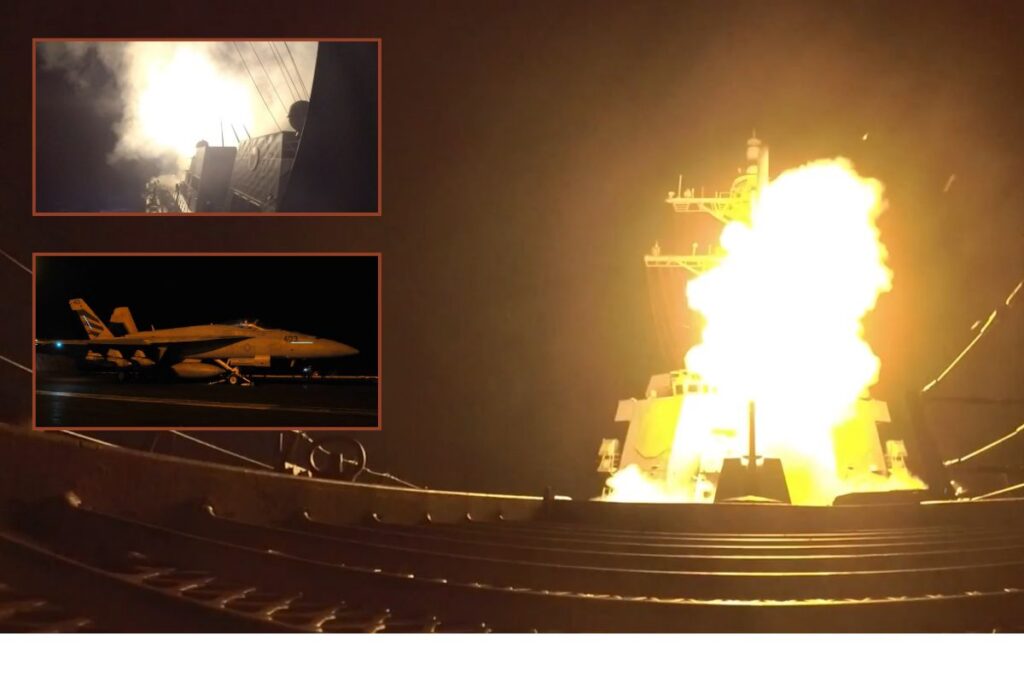
“One-way attack sea drones” were deployed in the latest round of American strikes against Iran as the ceasefire came under further duress.
The latest set of retaliatory strikes threw the prospect of a lasting peace deal into further doubt, with the Islamic Revolutionary Guard Corps (IRGC) today (Monday) targeting American military facilities in Bahrain and Kuwait, destroying radar systems in Oman and striking fuel and ammunition depots at Prince Hassan Air Base in Jordan.
U.S. Central Command (CENTCOM) said its forces had last night carried out a new round of strikes against Iran. Among 140 targets struck were Iranian military air defence systems, coastal radar sites, missile and drone capabilities, and small boats.
On Saturday CENTCOM said US forces had hit more than 300 Iranian military targets across three nights this week. It said last night’s strikes had used U.S. fighter aircraft, naval vessels, one-way attack aerial drones, and for the first time, one-way effector naval drones as well.
Its press statement noted: “The Strait of Hormuz is a vital maritime corridor for global trade. Iran does not control it.
“U.S. forces are postured and prepared to ensure that freedom of navigation remains available to commercial shipping despite Iran’s continued unwarranted aggression, harassment, threats, and arbitrary declarations.”
A 60-day U.S.-Iranian memorandum of understanding (MoU) was signed on June 17 extending a ceasefire. It sought to restore trade through the Strait of Hormuz and allow talks on Tehran’s nuclear programme and sanctions relief, the main bones of contention between the two sides.
The MoU began to come under increased strain when Iran attacked three commercial vessels in the strait last Monday. It said as they were crossing along an “unapproved” southern route. U.S. missiles fired in response marked an ongoing series of tit-for-tat exchanges.
Although he has left the door open to more talks, in the past week U.S. President Donald Trump has said he considers the ceasefire “over.” And Iran’s foreign ministry stated the latest wave of U.S. had “rendered futile all efforts of the past few months.”
At a Tehran press conference its Iran’s foreign ministry spokesman, Esmail Baghaei said Iran would not abide by the MoU if Washington failed to uphold its commitments to end the war, adding: “Each time that the other party has failed to meet its obligations, we did not uphold ours… We will continue to act in this manner.”
Trump has denied Iranian claims it had closed off the strait, insisting the US was keeping it open by force, and claiming the waterway was open to commercial shipping. The U.S.-run Joint Maritime Information Center said traffic was transiting at “reduced levels.”
An IRGC statement claimed the strait “is our territory” and it would not allow America’s “illegal interference.”
- You can read more details about the latest U.S. strikes on CENTCOM’s X feed