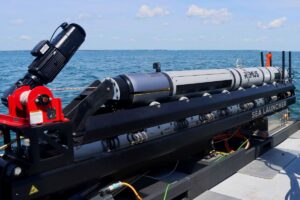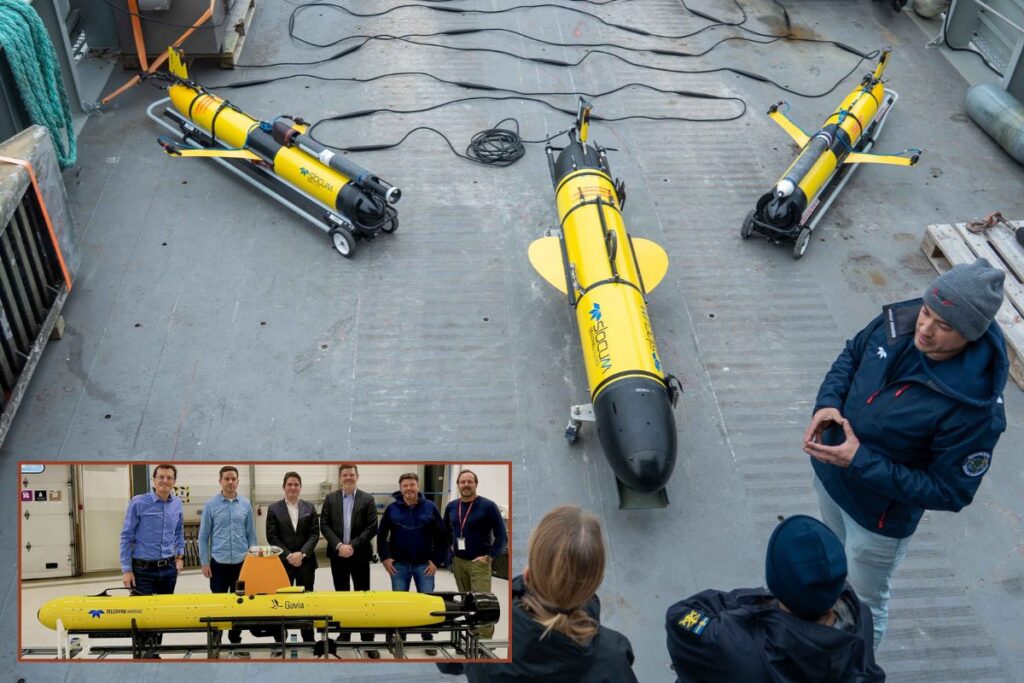
The Swedish Armed Forces have now bought four Gavia autonomous underwater vehicles (AUVs) they initially acquired under contract, according to manufacturer Teledyne.
The American company revealed in a recent social media post that it had just learned of the purchase from FMV (Försvarets materielverk) the Swedish Defence Materiel Administration.
In February last year FMV signed a framework agreement with Teledyne valued at SEK 190 million (about £14m), running through 2028 with options for extension. The drones were delivered in January 2026 this year.
The AUVs come equipped with EdgeTech 2205 side-scan sonar and Teledyne FLIR Blackfly-S cameras, and feature bays to swap in modular payloads such as synthetic aperture sonar, magnetometers, or multibeam echosounders.
Their primary missions include mine countermeasures (MCM), explosive ordnance disposal (EOD), seabed mapping, hydrography, underwater surveillance, and inspection/protection of critical underwater infrastructure (CUI),
A Teledyne statement read: “Their introduction into service further strengthens the growing NATO Gavia community in the Baltic region.”
During Navy Leaders’ Navy Tech Conference in Gothenburg in March 2026, the FMV ordered more Gavia AUVs and payloads under the same agreement; the exact quantity of the second batch was not publicly disclosed.
Teledyne has revealed the Factory Acceptance Trials of these additional drones had now been completed, and added a further 12 AUVs had now been ordered, with delivery due in 2027 and 2028.
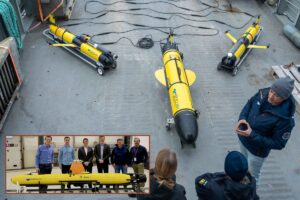
Earlier this month FMV and Teledyne teamed up to demonstrate some other autonomous underwater vehicles, Slocum underwater gliders, in the Baltic Sea in the waters off Gotland.
G3S and Sentinel variants were launched to demonstrate their functions and capabilities, with results presented to Swedish Navy representatives and other invited international guests, including representatives from Denmark, the Netherlands, Germany and the U.K.
The gliders — near-silent UUVs that move by changing buoyancy via small wings to conserve energy — were being used for passive acoustic detection using hydrophones and a towed array sonar (TAS).
Marine sensor systems engineer at FMV Elin Nolander said: “We wanted to give the Swedish Armed Forces the opportunity to test the vessels under conditions typical of the Baltic Sea, including limited water depths.
“During the tests, we managed to both detect a target vessel and transfer the information to a ship on the surface via underwater communication.”
Teledyne firm commented: “We are proud of the strong and productive collaboration between FMV, the Swedish Armed Forces and Teledyne, and look forward to continuing to support Sweden’s underwater survey capability for the years ahead.”
- You can read more about the Gavia AUV on the Teledyne website and more details of the testing on the Swedish FMV website