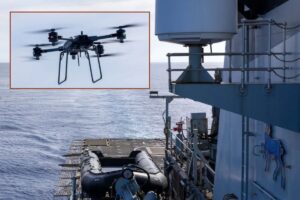
Shield AI has been demonstrating the High North resilience and capabilities of its V-BAT uncrewed aerial system (UAS) on exercises in Norway.
The first trials in Project HEIMDALL were hosted at the end of last month at NATO’s Centre of Excellence for Cold Weather Operations (CEO-CWO) in Elverum, Norway.
Named after a Norse God who acted as guardian, the acronym also stands for Harnessing Emerging technologies and Innovations for Multi-Domain capability Development in the Arctic Littoral Landscape.
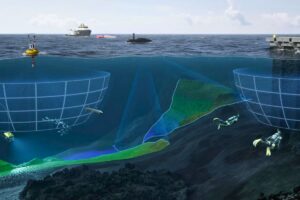
An ongoing effort to test, evaluate and develop uncrewed systems in real-world extreme environments, HEIMDALL is intended to develop into a counterpart to the annual REPMUS robotic experimentation exercises hosted in Troia, Portugal.
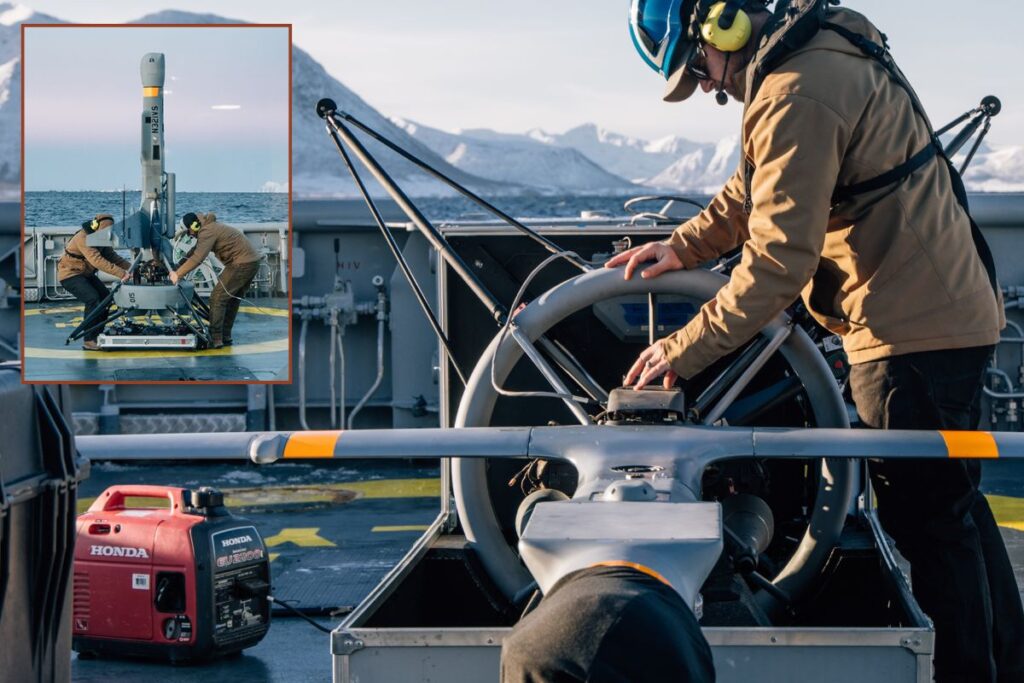
As per a Shield AI statement, last month’s tests provided a chance to validate V-BAT’s ability to operate in extreme cold and maritime conditions without aircraft modifications. They assessed the performance of its autonomous sensors amid snow-covered fjords and mountainous terrain.
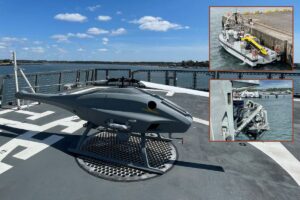
The Class I VTOL UAS can fly for more than 12 hours at a time and can be used for intelligence, surveillance and reconnaissance (ISR) and targeting. It can also be configured for strike missions. It stands just under 3m tall, has a wingspan of almost 4m, and a maximum payload of about 18kg.
Shield AI’s president and co-founder, former Navy SEAL Brandon Tseng, commented: “HEIMDALL was an excellent opportunity to prove V-BAT’s performance in real-world Arctic conditions. We launched from land and from smaller vessels, operated in harsh weather, and conducted surveillance across both maritime and land domains.”
The UAS successfully completed multiple ship-based vertical launch and land (VTOL) operations from Norwegian Coast Guard vessel KV Olav Tryggvason as well as land-based VTOL missions. Both day and night operations were conducted using a variety of payloads, including electro-optic and infra-red sensors and synthetic aperture radar.
Shield AI senior director Chris Brinkley added: “Cold-weather operations can present a range of challenges to unmanned aircraft system (UAS) operators, including icing, condensation, and extreme weather conditions such as cold temperatures and high winds. When moving into afloat maritime operations, these factors are significantly multiplied.
“Being able to work with customers such as the Norwegian Coast Guard and the Norwegian Armed Forces, who really know and understand cold weather operations, meant we were able to gain the best feedback on our platforms while utilizing a unique location.”
- You can read more details on the Shield AI website and the NATO ACT website