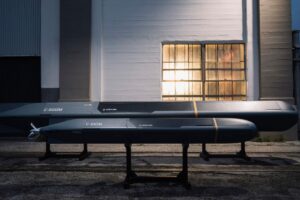
Raytheon has showcased the capabilities of its Barracuda semi-autonomous mine countermeasures (MCM) system during recent testing.
As per a recent press statement from the RTX firm, Barracuda was put through its paces in an open-water demonstration staged in Narragansett Bay, Portsmouth, Rhode Island, recently.
The uncrewed underwater vehicle (UUV) autonomously navigated, communicated, detected and identified targets. The untethered system is designed to track and identify bottom, volume and near-surface mines and can neutralise them too if so commanded by a “man-in-the-loop” operator monitoring its operations.
Barbara Borgonovi, president of Naval Power at Raytheon, commented: “This recent testing demonstrates the significant strides we’ve made in advancing mine countermeasure technology.”
She added: “Barracuda’s capabilities will dramatically improve safety and efficiency for the U.S. Navy, keeping sailors out of harm’s way while effectively addressing underwater threats.”
Barracuda is the newest U.S. Navy mine-disposal programme of record; the firm says it is on schedule to achieve initial operational capability and low-rate initial production by 2030. Raytheon says it is also developing a larger and more advanced variant of the system.
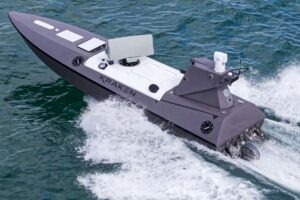
Barracuda is set to be deployed via the Mine Countermeasures Unmanned Surface Vehicle (MCM USV), an all-aluminum vessel developed by Textron Systems capable of deploying various mine countermeasure (MCM) payloads.
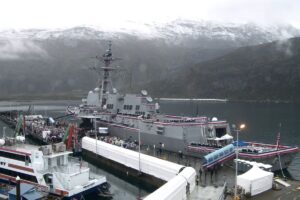
The Independence-variant littoral combat ship (LCS) USS Canberra was the first ship to be deployed with the Mine Countermeasures (MCM) mission package which includes the MCM USV and payloads in April 2024.
She has been deployed to Bahrain as the first of four of her class expected to operate in the region and she arrived at Naval Support Activity Bahrain at the end of May this year.
- You can read more details about Barracuda on the RTX Raytheon website and the U.S. Navy website