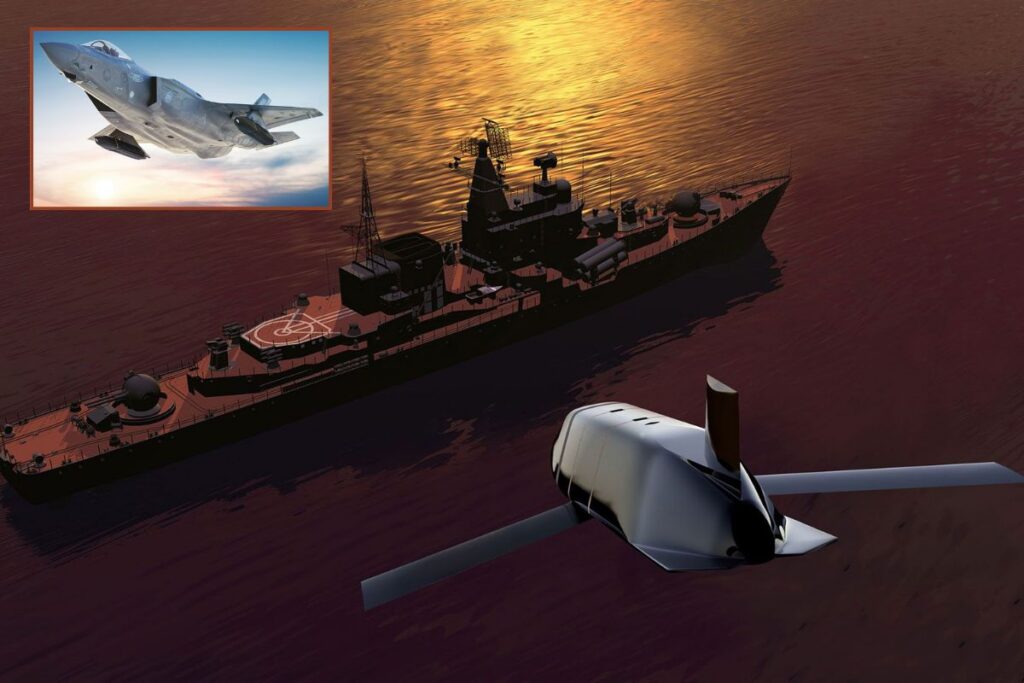
Lockheed Martin has announced it has completed the first phase of integrating its Long Range Anti-Ship Missile (LRASM) onto U.S. Navy F35-C fighter jets.
The LRASM is a precision-guided anti-ship missile designed for engagements outside the range of enemy vessels’ defences. Developed by America’s Defense Advanced Research Projects Agency (DARPA), the 4.2-metre missile flies at Mach 0.8, carries a 1,000lb warhead and has a range of about 500 nautical miles.
It is derived from the combat-proven Joint Air-to-Surface Standoff Missile (JASSM) and is capable of navigating semi-autonomously to a given target. On-board targeting systems aid it to independently acquire a target without GPS, and the projectile can employ counter-countermeasures to evade hostile active defence systems.
The F35-C announcement is the culmination of a series of test flights which began in September 2024 and which were completed in April this year.
The company’s vice president of F-35 Development Sean Jackson commented: “Integrating LRASM onto the proven fifth-generation F-35 is another example of how Lockheed Martin is enhancing the operational capabilities of the F-35, alongside investments from the U.S. military and its allied partners,” said.
Other platforms which have been or are being configured to carry the same missile include the F-35B, both configurations of the F/A-18 Super Hornet, the Boeing P-8 Poseidon maritime patrol aircraft, and the Rockwell B-1B supersonic swing-wing bomber.
Royal Australian Air Force (RAAF) F/A-18F Super Hornets also carry the LRASM.
- You can read more details on the Lockheed Martin website