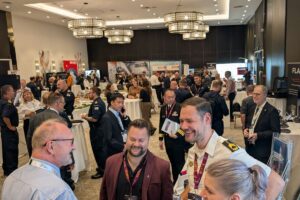
What a start it’s been to Navy Tech and Seabed Defence 2026 in Gothenburg, Sweden!
Its opening session was graced by presentations from the heads of both the Swedish and Finnish navies, and the defence ministers of both Sweden and Denmark also played a big part, taking part in a panel discussion together in the main plenary theatre.
While they were here, Swedish Defence Minister Pål Jonson and his Danish counterpart Troels Lund Poulsen also found time to take part in a press conference hosted by BAE Systems.
There, they announced an agreement to jointly purchase and deliver more Tridon Mk2 mobile anti-aircraft artillery systems for Ukraine to strengthen its air defences.
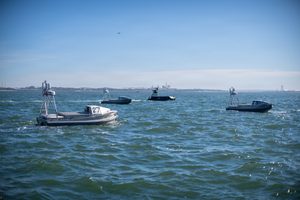
Meanwhile, among the many highlights of a packed first day were presentations on everything from protecting critical undersea infrastructure (CUI) to uncrewed systems, maritime security initiatives including Baltic Sentry, and the future direction of naval forces, including the Royal Navy’s move to a Hybrid Navy model.
In his opening address Head of the Swedish Navy Rear Admiral Johan Norlén talked about a “less predictable” geopolitical environment where “maritime security is under greater strain than at any point in recent decades.”
He told the audience: “Navies are at the centre of national survival. For our nations, security begins at sea, whether consciously acknowledged or not. If sea lines of communication are disrupted, everything else quickly follows.”
Adding that reaction times were now measured in minutes not days, and that the threats faced today are not those the Royal Swedish Navy was previously designed for, he said: “We should not be asking what platform should be replaced, we should ask what operational problem are we trying to solve?”
In his view, speed, relevance and adaptability now matter more than elegance. He wants a military more willing to experiment, its new maritime aim establishing and sustaining control across the Baltic Sea region enabling the free flow of trade, data and military forces.
This would be achieved through teamwork with other NATO nations, and that integration is achieved “not through declarations, but through daily work and shared systems.”
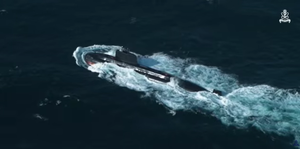
And he also noted: “Continued submarine development is vital, from now on in close cooperation with Poland.”
For Sweden, he said acquisition of air defence frigates — details of which are expected to be announced imminently — represents a new approach: “For the RSN, this is new territory.”
He characterised it as extending the navy’s existing green and brown-water expertise by “extending one foot into blue-water capabilities.”
Shortly afterwards, head of the Finnish Navy Rear Admiral Tuomas Tiilikainen took the stage. He talked about the Baltic Sea as a “complex and unique maritime environment” and how the maritime security environment was changing “as we speak.”
His wide-ranging speech also took in Finland’s total defence concept across all sectors of society, a resilience based on comprehensive security.
He noted lessons learned from Ukraine taught that more safeguarding was needed against hybrid threats, while longer-range weapons systems had brought increased capabilities, but also increased risk.
This necessitated a shift in military tactics, he said, adding: “The need for force protection cannot be overstated.”
He also remarked “Cooperation is not cost-free — it requires time and resources… but it’s a force multiplier.” This cooperation, he said, was being extended from Finland’s closest neighbours to the wider alliance.
A little later, Swedish defence minister Mr Jonson and his Danish counterpart Mr Poulsen took the stage for their panel discussion.
Mr Jonson talked about how protection of CUI had become a central concern in recent times, with at least five incidents where infrastructure had been affected in the past year.
He also raised concerns about increased spoofing and jamming issues, and how during the past two years “we have seen considerably more assertive behaviour by the Russian Navy.”
He highlighted the work of TFX Baltic in introducing uncrewed systems into the security effort and noted the Swedish Government had recently assigned SEK4 billion of investment into uncrewed systems across all domains.
He added Sweden was learning lessons from Ukraine about rapid procurement and working with companies at a variety of technological readiness levels (TRLs).
On cross-national data-sharing, he remarked: “Trust is fundamental: how we assess what is intelligence and what is information, and that we don’t over-classify.”
For his part Danish minister Mr Poulsen called for big investment in uncrewed systems, and continuing work on frameworks for sharing data and also sharing capabilities, “Otherwise I’m concerned that we will not be able to invest what is needed.”
On the subject of NATO and CUI, he said: “There has been quite a reluctance to discuss this issue…[but] during the last year we have seen a much more committed approach from NATO and all the Baltic nations have pushed for that.”
Exercises and operations like Baltic Sentry were the way forward, he said, and he called for better information-sharing, adding in the past that European countries had been “too dependent on our friends in the U.S.”
Talking about current procurement practices, he said: “We are too slow: we are not able to scale up, and it’s very costly to produce, and if we are not able to deal with that, it will give us big problems in the future.”
And he stressed the importance of dual-use technologies, especially with reference to his trip to Greenland a couple of days ago, where Denmark has been investing heavily in new technologies for commercial firms who will be able to feed their data back to the armed forces.
More insight into Demark’s own naval acquisition plans was afforded during the afternoon courtesy of a presentation on the future of the Royal Danish Navy.
Planned acquisitions include five new Arctic Patrol Ships (APS), elements of which will be built in different locations and then assembled at a new state-owned production facility to be built in Frederikshavn in northern Jutland.
The APS vessels, which will feature ice-breaking capabilities, have just passed their preliminary design review and are set to be delivered from around 2030 onwards.
There are also plans for one large and three smaller environmental protection vessels with mine-laying capabilities; combining these two functions is a more cost-effective, affordable approach.
No fewer than 21 new vessels are set to be acquired for the Naval Home Guard. These ships will largely be crewed by volunteers; in some cases they may be lean-crewed or even completely uncrewed, the speaker suggested.
More details of planned acquisition of an icebreaker and large numbers of uncrewed systems were also revealed.
And for its new frigates, Denmark is seeking to enter into a partnership agreement with another nation to share “experience and expense.” Continual upgrading of sensors and effectors on frigates was the biggest driver for this approach, the audience was told.
The choice of platform, acknowledged as “a big political decision,” is due to be made and announced this spring.
Another highlight today was an insightful presentation on Britain’s Royal Navy (RN) and specifically its plans for making its much-heralded transition to a Hybrid Navy.
Why change? The audience was told that in terms of what the force needed to deliver in future: “This isn’t an optional change for us: we know that the previous model doesn’t work.”
Cited challenges included the changing security climate and developing technology but also issues of affordability, changing demographics and even increased instability brought on by climate change.
Hybrid Navy, the audience heard, was not a set of capabilities but a “design philosophy;” a new means of delivering the key priorities of homeland defence, maritime strike capability, global presence and a continuous at-sea deterrent.
The aim was to deliver a balance of mass and exquisite platforms, not “exquisite and more exquisite.”
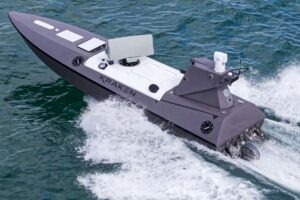
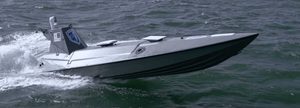
The key premise was replacing categorisations such as “frigate” or “destroyer” with the concept of optimally-crewed “common combat vessels” (CCVs) as decision-making command and control platforms, complemented by a mix of large uncrewed surface vessels (LUSVs) fulfilling diverse roles such as, for example, air defence or anti-submarine warfare as missions demanded.
The speaker said it was believed this approach would still be more affordable than the present approach, citing savings in terms of design, assembly, crewing requirements, training, and increased capability availability.
And higher overall numbers of vessels would also deliver benefits in terms of increased flexibility in deployment, he said. In other words: “I cannot be superior everywhere, but I can achieve relative superiority where it is needed.”
In terms of delivery, the First Sea Lord has tasked the RN to “get the first uncrewed platform in the water within two years, and we believe we are on track to do that.”
The speaker said in transitioning to the Hybrid Navy model, the first CCVs would be Type 45 destroyers, a role also set to be adopted by new Type 26 and Type 31 frigates as they came into active service.
He added Level 3 autonomy — uncrewed remote-controlled platforms — would initially deliver a minimum viable product, but warships with Level 4 autonomy would represent a huge step forward in the Hybrid Navy concept.
And he closed with a Lego analogy, saying what was needed was a future Navy where all the discreet parts fitted together in virtually any arrangement required to suit future needs as they arose.
This insightful presentation came towards the close of an opening day packed to the brim with content, analysis and discussion: more in the same vein is sure to follow on days two and three. Stay tuned!