Whether you were littoral-minded by nature or more of a deep blue-water thinker, there was plenty to keep your attention at Day Two of Navy Tech and Seabed Defence 2026.
Today (Wednesday) saw the conference split into streams, with four central themes: surface technology; communications, data and networks; underwater technology; and seabed defence.
Among the day’s early presentations was a mind-stretching talk on the European Space Agency’s ScyLight optical and quantum satellite communications project.
Today the prevalence of video and demand via terrestrial broadband networks means that satellites once primarily used for delivering broadcast television programmes are refocusing on a new business model: information transmission. In the words of the speaker: “They have lost their raison d’etre and found a new one: data.”
The audience learned resilience was one of the potential benefits of using lasers for fully optical satellite data transmission, contrasted with terrestrial infrastructure that could be more easily damaged, either by accident or design. Laser communications are also much harder to detect and intercept.
The presentation also gave a brief insight into some of the how, as well as the why: essentially quantum communication exploits the counterintuitive notion of subatomic entanglement, also known as spooky action at a distance, where particles in different physical locations can be interacted with and changed instantaneously.
It was noted that there were some parallels between underwater communication challenges and space-based ones: both environments are both harsh and inaccessible. It was pointed out that you only get to launch a satellite once, and with repairs somewhere between impractical and impossible, you’d better get it right first time!
The main takeaways were that in this emerging field, long lead times mean work needs to start now. Also, optical communications will never completely replace radio transmissions, or vice versa: a hybrid approach is needed for resilience.
Elsewhere early on Day Two, in the Seabed Defence theatre there was an illuminating panel discussion on to how to best utilise the innovations in the private sector to protect critical undersea infrastructure (CUI).
Prevention — essentially detecting the adversary before potential acts of sabotage can take place — was one natural topic of discussion. Other valid and valuable suggestions included finding ways to make sabotage less attractive to carry out.
As one speaker remarked: “In Ukraine, Russia stopped attacking certain targets because they are getting repaired so quickly, and the cost of carrying out the attack becomes too high.
“For data cables this is easier because they can be repaired fairly easily; it gets harder with power cables… How can we cut the time it takes to repair these?”
There was also a call to ensure that the quality and integrity of data gathered from all the disparate systems in play stayed high: “Everything builds from there, otherwise we are building on sand.”
And there was also a call to maximise data-sharing, both in terms of volume to facilitate better and faster machine learning for AI models, and between nation-states, with classified status used as sparingly as possible.
In another stream the audience heard about lessons learnt from Exercise Counter Sabotage, run by the Royal Norwegian Navy’s Explosives Ordnance Disposal (EOD) section.
Conceived shortly after the Nord Stream pipeline explosions in 2022, last year’s exercise focused on developing civilian and military cooperation for sabotage scenarios, foiling sabotage and hybrid threats, and advancing bilateral and potentially multilateral collaboration between nations.
A range of scenarios were staged including suspicious devices placed in tunnels, on bridges, and on subsea infrastructure: potential targets of attacks identified included donators of equipment destined for Ukraine. As well as military EOD crews, police and civilian organisations were involved, and elements from Swedish EOD teams.
The speaker outlined some of the key lessons learned from the exercise, which included an identified equipment shortfall in X-ray equipment capable of being used at depths of up to 100 metres. As he succinctly put it: “If there’s a device placed on an oil or gas pipe, we have to be able to see what it is.”
Other takeaways included the need for stakeholders such as energy firms to access the same communication systems used by EOD teams.
Also, amid a recent focus on remote-operated vehicles (ROVs), there was a need to constantly assess the most effective tool for any given task. Sometimes using canine assets for shore-based detection scenarios is much more efficient, for example.
And EOD teams needed to be mindful to work in a forensically sound way, in collaboration with police experts, to maximise the potential for attribution of acts of sabotage.
Future exercises will further explore aspects including increasing the speed of underwater ROV use, and getting tasked to investigate potential threats via alerts from autonomous uncrewed surveillance systems.
Threats from uncrewed systems of a different kind were the focus of a later presentation by the Swedish Defence Research Agency on high power microwaves (HPM) as counter-uncrewed aerial systems (C-UAS) weapons.
It gave a useful overview of the background to the weapon systems’ development, which can essentially be traced back to the discovery of the destructive power of the electromagnetic pulse (EMP) emitted by nuclear detonations.
EMPs are long-waveform phenomena, and setting off a nuclear explosion is hardly a practical or sustainable means of generating them. But modern Directed Energy Weapons (DEWs) substitute this with rapid bursts of HPM, with the short waveforms and brief, targeted emissions mitigating overall power requirements.
Different types of HPM weapons operate in different bandwidths, categorised as narrow, wide, and ultrawide. This matters because different drones are sensitive (i.e. vulnerable) to different frequencies, and using the right type for the target increases the effectiveness of the weapon exponentially.
Shielding can protect them to some extent, but the most vulnerable parts of drones to HPM weapons tend to be wiring and communication antennas on non-autonomous systems. And the chief advantages of using a DEW for C-UAS are cost, plus the potential to hit multiple drones in a swarm with the same or relatively few shots.
The alternatives are bullets or missiles, and as the speaker put it: “It’s quite expensive to fill the sky with projectiles.”
A talk on special operations developments in the Indo-Pacific was fascinating, and also grew into a wider consideration of the nature of modern conflict generally.
As per the speaker’s thesis, just like in Europe, the Indo-Pacific region is daily facing great power competition and daily experience of grey-zone tactics; if reports are to be believed, China is preparing for action against Taiwan either this year or the next.
He drew possible parallels between grey-zone tactics employed by the Japanese in using its fishing fleet for reconnaissance in the years leading up to the Pearl Harbour attack in 1941 and contemporary Chinese activities. And he added that the Japanese campaign planning had been similar in its nature to that recently used by Russia in Georgia and Ukraine.
“History shows us that a binary… model of ‘peace or war’ is inappropriate,” he argued, saying instead that competition “continues in conflict.”
And since the advent of the nuclear age, in what’s termed the stability/instability paradox, states are motivated to avoid outright war in favour of “deniable means of conflict,” many of which fell within the remit of special operations forces, including support to non-state actors.
He talked about the concept of “unconventional deterrence” and countering grey-zone tactics, which advance states’ aims while falling short of the threshold of outright war.
Other presentations remained far more firmly centred on specific programmes. There was a comprehensive presentation on the Future Force Design of the Swedish Marine Battalion 2030, which the speaker suggested might be more properly characterised as coastal amphibious forces.
The audience heard that 70% of the world’s islands were to be found in the Nordic nations, hence the historic focus of the Swedish Navy on littoral capabilities. Today, there are two Marine battalions: the 2nd, based in Stockholm, and the 5th, based here in Gothenburg.
The Marine Battalion 2030 project was motivated by a number of different factors including the development of Russian capabilities, equipment lifecycle renewal requirements, changing domestic contexts, and Sweden joining NATO.
A comprehensive planning process began in 2015 and involved all stakeholders early on, a key component of its success, the speaker argued.
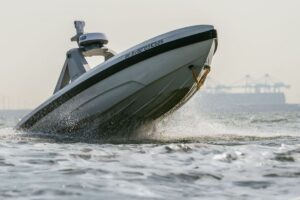
The force uses CB90 boats as its ‘workhorse’ throughout its fleet. Imminent new capabilities include a NEMO mortar-touting variant, a version equipped with lightweight torpedoes for ship-killing capabilities, one equipped with radar sensors on an extendable antenna, a missile-carrying variant, and ones with short-range and very short-range air-defence capabilities and remote weapons stations.
The plan is to integrate all the above into a data-centric dynamic kill web working on any sensor, any shooter principles; as the speaker noted: “It doesn’t matter how many shiny things you get if you can’t connect them together.”
Some of the new systems will start getting fielded later this year; others are set to be delivered from 2027 and 2028. But he stressed: “This is not just a Powerpoint presentation; they are tangible and real.”
With the new capabilities will come an evolution in tactics and doctrine, too: coastal defence capabilities are now complemented by an ability to contribute towards sea denial and sea control aims, as well as lending the force a new potential capability to gain littoral access in a contested environment.
The speaker said the force could deploy to key NATO-strategic Baltic terrain at immediate notice: to Baltic Sea chokepoints bordering Denmark in 4-8 hours, and into Estonian waters in 12-24 hours as required.
Another briefing gave a fascinating insight into a project slightly less tangible but no less impressive or useful: the Royal Navy’s Maritime Domain Awareness (MDA) Programme.
The MDA, which draws data from non-military sources to augment and improve decision-making, is awesome in terms of its sheer scale: the audience heard how in this digital age, the programme receives 200 million reports a day, each with their own subfields.
It stretches across every domain — seabed, underwater, surface, air, space and cyber — and comprises data from around the globe. Why? “We record data from the other side of the world, because we don’t know where we are going to operate.”
Also, it may well prove useful to partner nations and allies. Currently, about 15 years’ worth of data is recorded and stored. Why is that important? Partly, because it builds an idea of what ‘normal’ looks like — interrogators of the system can check anomalies by asking, has this happened before?
And it also provides a rich data source on which to train AI algorithms which are essential for timely analysis of such huge data sets. The audience was told that data assembly tasks which traditionally might have taken humans three months to compile can be pulled together by machines in about 30 seconds.
What’s the future direction of the programme? Making sure this vast resource of relevant data can be boiled down into actionable intelligence delivered to military commanders in kilobyte sizes, not gigabytes, to aid them to come to optimal, timely and informed decisions.
And as the speaker put it: “We are very good at what has happened, and we are not bad at what is happening; we want to get better at what will happen.”
A day packed brimful of content was rounded off in one theatre with a review of Task Force X Baltic. The audience heard about its notable successes, including the 70-strong uncrewed fleet assembled for the demonstration during the NATO summit in June last year.
It’s hoped that 12 months on, a similar event can be staged; hopes are that this June the TFX Phase II demo will be with assets fielded by nations rather than NATO; either their own assets, or company-owned, company-operated (COCO) systems contracted by countries.
There are also nascent plans for an Italian-led Task Force Adriatic and a Netherlands-led Task Force North Sea, we were told.
The audience also learned about some other notable successes, such as when a drone sailed out to what was apparently a motorboat, but turned out to be a Russian warship in the Gulf of Finland, spoofing its AIS signal.
Key lessons taken from the first year of TFX Baltic are that there’s no ‘silver bullet’ — no one system can perform all tasks needed, and a combination of assets is the best solution.
Also, data integration, while difficult, remains vital: “When 100 sensors are tracking the same vessel, I want to see one dot on the screen, not 100.” And on a related note, getting the middleware right — the systems between the sensor inputs and the display outputs — is a key part of that.
Adoption and promulgation of STANAG 4817, a NATO standard for uncrewed system data, will help immensely in this regard; it’s hoped this will be implemented from March this year. Other challenges remain, including resolving legal questions.
If an uncrewed vessel, particularly a COCO one, crashes, causes damage, or hits another vessel, who is responsible? The firm? The country? NATO? But as the speaker pointed out: “But we have to take risks, or we never innovate.”
There’s lots more great stuff to come as we return to twin plenary sessions on Day Three, the final leg of this year’s event. Stay tuned for another whistlestop summary tomorrow.