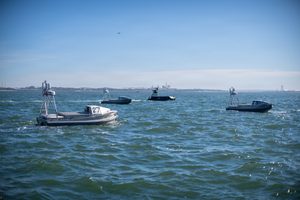
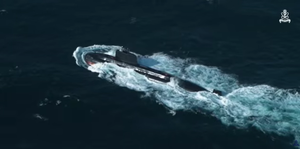
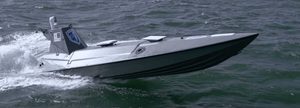
Keeping the harbour secure, or sneaking into it undetected: these were the two contrasting aims of firms taking on the challenge posed by SeaSEC and Navy Leaders in Gothenburg today (Monday).
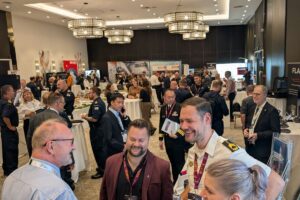
Heads of navies and around 100 other end-users and agency procurement representatives came along to watch the Harbour Protection Challenge Day run by the Seabed Security Experimentation Centre (SeaSEC).
The exercise was staged in sub-zero conditions in a section of Gothenburg harbour ahead of Navy Leaders’ three-day Navy Tech and Seabed Defence 2026 conferences being staged in the Swedish city from tomorrow (Tuesday) onwards.
Participants were split into Red and Blue teams. In two separate 90-minute runs, Red Team firms were tasked with attempting to infiltrate the designated port area without detection.
Their aim was to map the subsea surveillance infrastructure, including sensor types, locations, and coverage zones, in preparation for a hypothetical future sabotage mission.
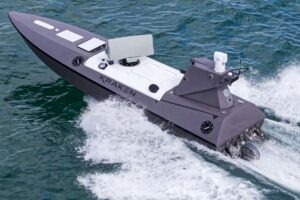
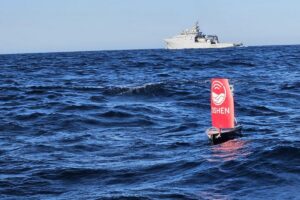
They adopted discreet reconnaissance techniques, utilising USVs (uncrewed surface vehicles), ROVs (remote operated vehicles) and autonomous UUVs (uncrewed underwater vehicles) to identify underwater sensors, infrastructure and cabling.
Their success was to be measured by how comprehensively they could survey the designated operating area and the extent to which they could remain undetected.
Conversely, Blue Team firms sought to maintain continuous surveillance, deliver uninterrupted situational awareness, and classify anomalies within the harbour zone.
Capabilities used included Passive Acoustic Monitoring (PAM), Distributed Acoustic Sensing (DAS), Forward Looking Sonar (FLS), and Diver Detection Sonar (DDS) systems under the surface and EO/IR (Electro-Optical/Infrared) cameras above the waves.
Three further firms aligned with neither team were tasked with collating all the data and fusing it together into a common operational picture.
Thirteen industry partners participated in the challenge: Alcatel Submarine Networks; Axient Systems; Blueye Robotics; Elwave; Fugro; Knowit; Lobster Robotics; Maritime Robotics; Norbit; Optics 11; Technolution; Teledyne; and Unified International.
As Captain Per Ohrsted, Director of the FMA (Sweden’s Defence Materiel Administration) noted in his introductory remarks: “Gothenburg is showing its wintry side, but that’s a challenge that we always need to be prepared to work in.”
Pointing out how in recent years the Baltic Sea had become “a focal point for grey-zone and hybrid threats,” he added: “Our presence here today is an indicator of how vital our maritime infrastructure is. Protection of CUI is not something any single country can manage alone. Co-operation is essential.”
By common consent the day was a big success, allowing observers to see both sensors and uncrewed systems in action. It also afforded some insight into the challenges of collecting all the data and aggregating it into a near-real-time common operational picture.
Harbours by their nature can be difficult places to secure; while they are relatively small in terms of total area, high levels of passing traffic above and below the waves, environmental noise, and echoes off walls pose extra surveillance difficulties when compared to open-water environments.
And the freezing operational conditions brought an extra set of challenges for the firms, with surface ice floes posing a damage risk to some passive sonar sensors and providing excessive noise echoes on LIDAR scanners, and sub-zero temperatures icing up thrusters on some of the vehicles.
But these hurdles were welcomed as useful learning experiences by the operators, and SeaSEC director Carine van Bentum was full of praise for contributors for both their openness in admitting where they had encountered problems, and their ingenuity in overcoming some of them.
In her concluding remarks she commented: “We wanted realistic conditions, and we got them… For me this is a positive outcome.”
While the data fusion companies present had done a brilliant job, she said, it was clear there was still more to be done. And in terms of harbour defence, her main takeaway was: “The combination of sensors is what will work, and it’s not one sensor that will do the job.”
SeaSEC will be putting together a comprehensive report, available on request, setting out in detail what has been achieved and learned at today’s event in due course. And Carine added the experience gained in Gothenburg would prove invaluable as SeaSEC prepared for its forthcoming extended challenge in Rostock, Germany in April.
- SeaSEC is part of the Northern Naval Capability Cooperation, a joint alliance of six Ministries of Defence (Denmark, Finland, Germany, the Netherlands, Norway and Sweden). It seeks to accelerate the capabilities and adoption of maritime uncrewed and autonomous solutions, with an immediate focus on protecting critical subsea infrastructure (CUI).