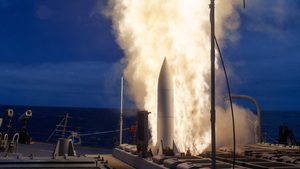
Raytheon has signed a new seven-year, $22.9 billion deal to supply more than 1,000 Tomahawk cruise missiles to the U.S. Navy.
Acting Secretary of the Navy Hung Cao revealed yesterday (Monday) that a contract had been signed with the RTX firm to dramatically accelerate the production of both Land Attack and Maritime Strike variants of the Tomahawks.
Mr Cao asserted: “By working closely with industry to expand the capacity of our munitions industrial base, the Department is utilizing every available tool to meet the demands of current operations, guaranteeing our naval and joint forces have the lethal firepower they need to deter aggression and protect the homeland.”
As per the U.S. Navy press statement, the commitment has been made to provide industry with greater stability and predictability, enabling firms to expand workforce capacity, and reinforce supply chains.
It added: “This action reinforces the Department’s commitment to rebuilding the defense industrial base and ensuring Navy and Marine Corps forces remain equipped with the advanced weapons required to maintain maritime superiority.”
Raytheon’s President Phil Jasper remarked: “Tomahawk is the Navy’s most important strike weapon, able to target hostile forces hundreds of miles away without ever risking the lives of our sailors.
“We are making significant investments in our workforce, technology, supply chain and facilities to dramatically boost production capacity and meet surging demand.”
The company said it had already delivered three times as many Tomahawks in the first half of 2026 as it had the previous year, and pledged to continue to “rapidly scale output to meet long-term needs.”
- You can read more details on the U.S. Navy website and the RTX website