The Royal Navy has achieved a series of firsts with its uncrewed underwater vehicles (UUVs) during exercises in the Mediterranean and off the coast of Australia.
According to a recent RN press statement, one of its Astute-class nuclear-powered attack submarines successfully launched and recovered a UUV from a torpedo tube during a recent trial in the Mediterranean Sea.
The experiment formed part of activities under Project Scylla, an AUKUS Pillar 2 programme. The Torpedo Tube Launch & Recovery (TTL&R) capability development is based on the L3Harris Iver4 autonomous underwater vehicle (AUV).
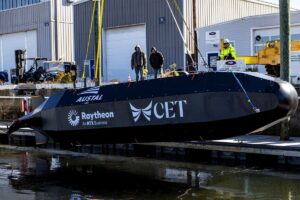
And in a separate set of experiments conducted as part of the ongoing Exercise Talisman Sabre 25 in Australia, AUKUS partners the U.K., U.S. and Australia are testing their new subsea warfare capabilities, including communicating with autonomous systems underwater.
A U.K. Ministry of Defence press statement said AUKUS nations “will demonstrate the ability to remotely control Extra Large Uncrewed Underwater Vehicles (XLUUVs) from a remote operating centre.”
Experts from its research arm, the Defence Science and Technology Laboratory (Dstl) helped test autonomous systems “able to find and strike an advancing adversary.”
It added: “This experimentation provided a realistic combat environment for AUKUS to operate as an AI-enabled, integrated force, exploiting cutting-edge technology to ensure strategic advantage against a range of simulated adversaries.”
As per a Defence Australia press statement, the AUKUS partners have jointly tested their ability to communicate with AUVs during Exercise Talisman Sabre 2025, as part of AUKUS Pillar II’s Maritime Big Play series.
It said Japan also joined the activities for the first time, which involved transferring mission control of a XLUUV located in the U.K., back to the U.K. remotely from Jervis Bay, Australia.
Speaking about the Project Scylla experiment, Deputy Director of Underwater Battlespace Capabilities Commodore Marcus Rose commented: “Delivery of these trials demonstrates our commitment to the use of advanced capabilities as part of a future hybrid Fleet and are a big step forward in delivering new capability to the Submarine Service.”
And speaking about the Talisman Sabre trials, U.K. Carrier Strike Group commander Commodore James Blackmore added: “Exercise Talisman Sabre is also an opportunity for the U.K. to develop new levels of integration between systems and capabilities with the U.S., Australia, and other partners, enhancing our interoperability even further and to unprecedented levels.”
Defence Australia’s Stephen Moore, First Assistant Secretary AUKUS Advanced Capabilities, commented: “Maritime Big Play tangibly contributes to AUKUS’ partners interoperability in the maritime domain, and supports collective deterrence and stability in the Indo‑Pacific.
“Communicating underwater is no easy feat — but Maritime Big Play is helping make this happen faster. The multilateral scale and complexity of Talisman Sabre provided the ideal ground for Maritime Big Play to test cutting-edge technologies.”
- You can read more details on the U.K. MoD website, the Royal Navy website and the Royal Australian Navy website