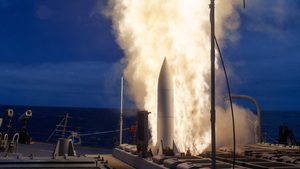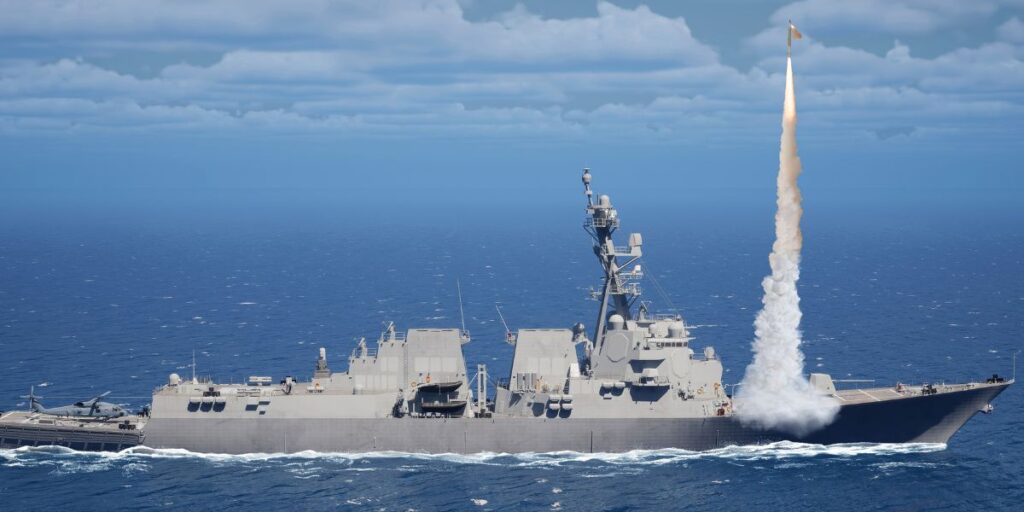
The U.S. Navy has given the green light for the newest PAC-3 MSE missiles fired by the Patriot air defence system to be integrated into the Aegis Combat System used by its Arleigh Burke-class destroyers.
As per a press statement, Lockheed Martin has announced it has signed a contract with the U.S. government for the development, integration and testing of the PAC-3 Missile Segment Enhancement (MSE) into its Aegis system, which provides integrated air, surface, and ballistic missile defence (IAMD).
More than 80 U.S. Navy vessels are equipped with the Aegis Combat System, including the majority of its Arleigh Burke-class destroyers and a number of its Ticonderoga-class cruisers.
The U.S. Army and 16 allied nations globally use the PAC-3 MSE missile. It is just over 5m long, has a range of about 45 miles, and a ceiling in excess of 24,000 feet; it flies at speeds in excess of Mach 5.
Unlike older variants used by the Patriot system, such as PAC-2 that exploded near targets using blast fragmentation, PAC-3 MSE missiles employ “hit-to-kill” technology, destroying targets via direct high-speed impact.
Compared to the older PAC-3 CRI variant, the MSE projectile features a larger, dual-pulse solid rocket motor for increased range and altitude, as well as bigger fins and actuators for enhanced manoeuvrability to better cope against modern hypersonic and ballistic missiles.
Earlier this year Lockheed Martin won a $4.7 billion contract from the U.S. government to ramp up production of the PAC-3 MSE interceptors, aiming to triple annual output from about 600 in 2025 to more than 2,000 across the next seven years.
Lockheed Martin IAMD vice president and general manager Jason Reynolds commented: “By integrating PAC‑3 MSE’s capabilities into Aegis, the Navy is taking a decisive step forward in defending America’s fleet and our global interests against the most advanced threats.”
Its Multi-Domain Combat Solutions VP Chandra Marshall explained: “This integration further expands the capability of Aegis to engage missile threats at multiple layers, enabling a more comprehensive and effective defence against evolving threats.”
- You can read more details on the Lockheed Martin website