German defence firm Euroatlas is beginning what it describes as extensive Baltic Sea operational testing of the new hydrogen-cell-fuelled variant of its Greyshark underwater drone.
The autonomous underwater vessel (AUV) has been designed for persistent maritime security missions, including protection of critical underwater infrastructure (CUI) such as subsea cables, and long-range intelligence, surveillance and reconnaissance missions.
On Wednesday at its marina in Damp, just north of Kiel in Schleswig-Holstein, the firm welcomed Dr. Christoph Ploss. The German Federal Government’s Maritime Coordinator, his responsibilities include developing and implementing national strategies, coordinating the expansion of offshore wind energy, and liaising with the shipping and shipbuilding industry sectors.
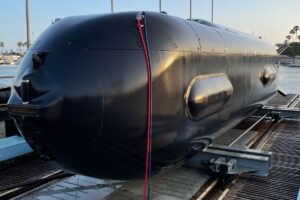
The outing marked the first public display of the “Foxtrot” variant of the Greyshark, which the firm said it has named “Franzi.” The AUV is now destined for an extended period of operational trials in the Baltic Sea.
Greyshark comes equipped with a suite of 17 integrated sensors, including Synthetic Aperture Sonar (SAS), multibeam echosounders, LIDAR, and multispectral AI-powered cameras.
Its hydrodynamic penguin-inspired shape and cruciform rudder allow for near-vertical dives and give it a very small turning radius. It has a flooded-hull design and is currently rated to a depth of 650 metres; Euroatlas has a target depth of 4,000 metres for future iterations.
The platform, developed in partnership with EvoLogics, was first unveiled in 2024. Its “Bravo” battery-powered variant is 6.5m long, has an endurance of around five days and maximum range of about 550 nautical miles. Its payload bay can also be equipped for minelaying missions, and the AUV can be launched from planes, ships or coastal bases.
The new larger 8-metre “Foxtrot” variant is intended for more persistent ISR or CUI monitoring missions, and is powered by a hydrogen fuel cell. It can remain submerged and operational for about four months at a time, with a maximum range of up to 11,000 nautical miles.
If used for anti-submarine warfare (ASW) it can sit passively on the ocean floor to “look and listen” for submarines, only surfacing to deploy its antenna and report detections via satellite when necessary.
Both versions have Level 5 autonomy and can work collaboratively in swarms. They can operate in all conditions without human intervention and carry onboard AI for object recognition, collision avoidance, and sensor fusion.
- You can read more details about the Greyshark AUV on the EuroAtlas website and on its LinkedIn page