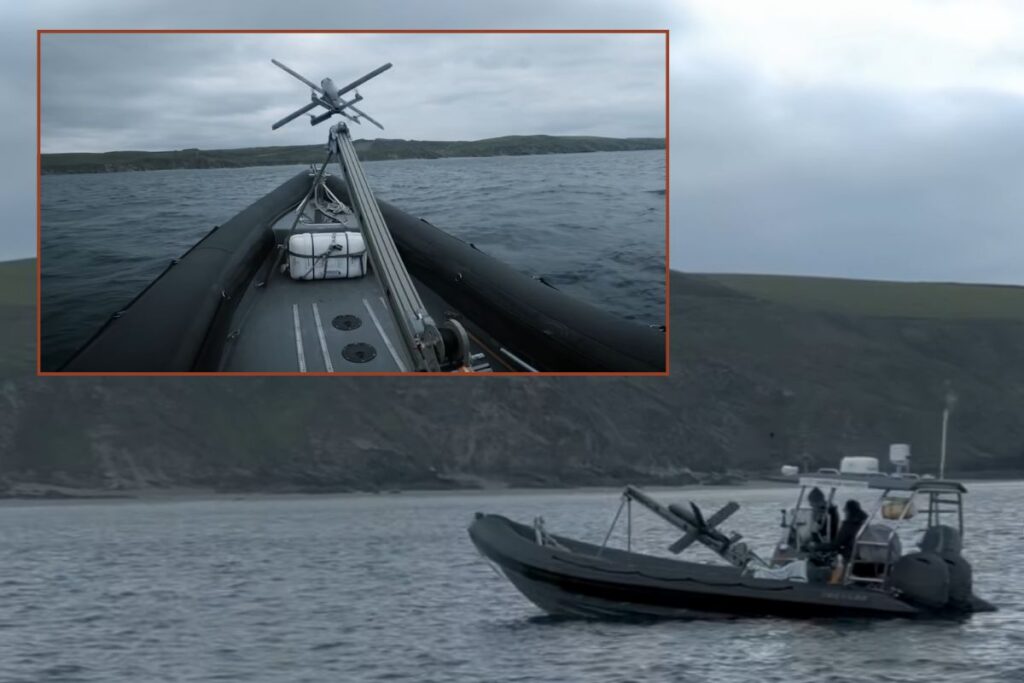
Helsing has revealed it recently launched its HX-2 loitering munition from a coastal platform for the first time in trials off Plymouth.
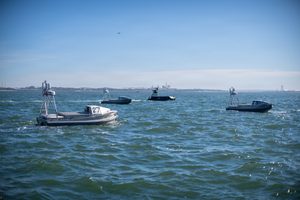
The firm announced via social media channels that the strike drone had been successfully deployed from a fast insertion craft for the first time in a test conducted off the coast of the Devon city, home both to Helsing’s U.K. facility and the National Centre for Marine Autonomy.
HX-2 is a loitering munition developed in 2024 by the German firm with input from Ukrainian operators to provide autonomous, electronic-warfare-resistant strike capabilities. Last year Germany ordered 6,000 units of the uncrewed air systems (UAS) for use in Ukraine.
The HX-2 has a range of about 60 miles and uses on-board AI to recognize, re-identify, and engage targets, allowing it to function even if communication with the operator is severed by electronic warfare.
It uses camera-based terrain navigation, comparing live images to a digital map, allowing operation without GPS.
Used alongside Helsing’s Altra software, a single operator can control multiple drones for coordinated swarm strikes. A human operator stays in the loop for all strike decisions.
The UAS can carry a variety of different payloads, including anti-structure munitions and an armour-penetrating shaped anti-tank charge.
As per Helsing’s statement: “We are moving fast to further extend the operational capabilities of the HX-2, building on our experience on the battlefield in Ukraine.”
- You can read more about the HX-2 on the Helsing website