Shield AI has revealed flight tests of X-BAT, its AI-piloted, vertical takeoff and landing (VTOL) fighter aircraft, will begin before the end of this year.
The announcement comes as the firm revealed significant extra investment in its drone fighter programme. The company has received an additional $150 million from the U.S. Navy and is matching that sum in private investment.
It is also match-funding a separate $50 million investment from the Defense Innovation Unit (DIU) under its Runway Independent Maritime Expeditionary Strike (RIMES) solicitation. The cash injections bring the total investment in the new capability to in excess of $400 million.
In a recent press statement the firm delivered a progress report on the project, which is being worked on by a team of 500 engineers at Shield AI and other suppliers, including GE Aerospace.
Test platforms are being constructed with a view to getting the first drones in the air before the end of 2026. Wind-tunnel work has confirmed the design of the fighter’s weapons bay, and the details of the thrust-vectoring nozzle which will afford the drone high manoeuvrability.
Work has also been ongoing on integrating the Hivemind AI piloting software controlling the X-BAT in flight
Senior vice president of aircraft at Shield AI Armor Harris commented: “We are testing early and often while working on the aircraft, mission systems, ship suitability and production in parallel.
“That approach helps us identify and resolve issues earlier, reduce development risk and move more quickly toward flight testing.”
The DIU RIMES initiative is seeking long-range strike assets capable of taking off and landing vertically from ships, islands and austere sites, extending strategic reach of surface and expeditionary assets without needing a runway.
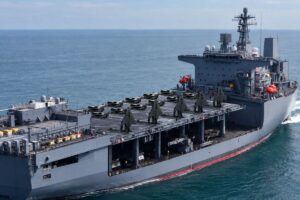
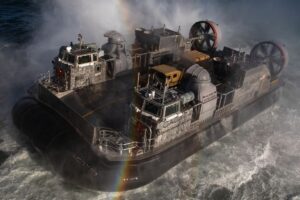
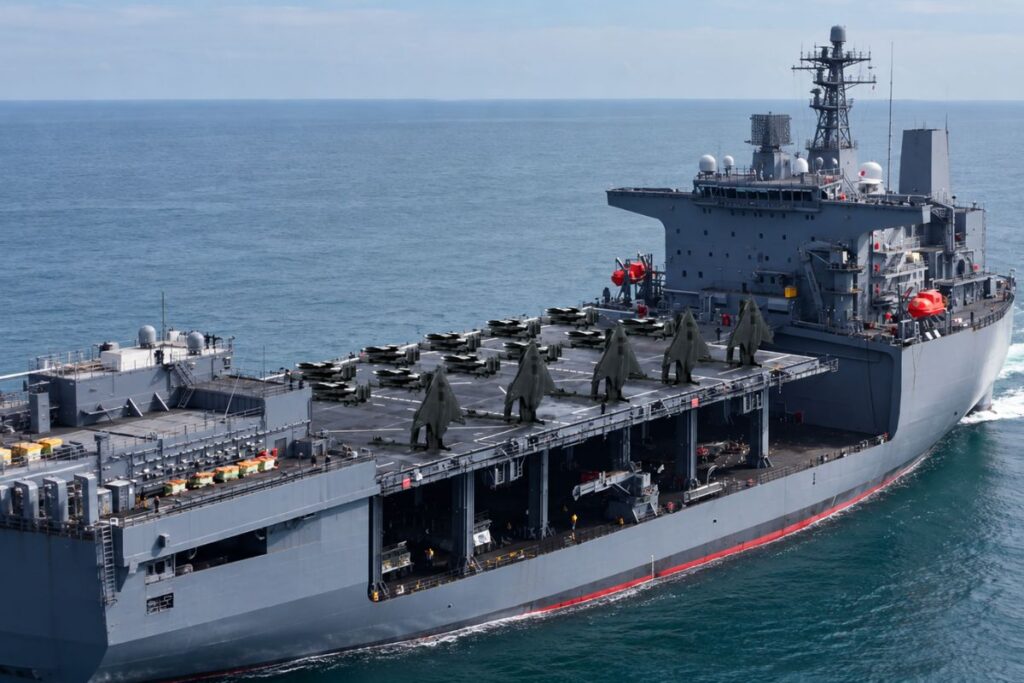
Shield AI’s head of mission solutions for the U.S. Navy J.J. “Yank” Cummings said the X-BAT was being designed to operate from a range of platforms including aircraft carriers, landing helicopter assault (LHA) craft, landing helicopter docks (LHDs) and expeditionary sea bases (ESBs).
He added: “Just as important, we are designing it for safe, high-tempo manned-unmanned flight deck operations and integration with the missions and capabilities of the carrier air wing, so X-BAT can add combat power without compromising existing operations.”
The company’s V-BAT uncrewed aerial system (UAS) is already in use with a number of Western navies for ISR. The VTOL drone stands just under 3m tall, has a wingspan of almost 4m, and a maximum payload of about 18kg. It can fly for more than 12 hours at a time and can also be configured for targeting and strike missions.
In June the Polish Navy announced it was buying V-BATs to “support Polish Navy operations;” earlier the same month it was revealed that the Hellenic Army had signed a procurement deal to acquire up to ten extra V-BATs for ISR missions in the Aegean Sea; Greek Armed Forces had initially trialled two of the drones.
The Royal Netherlands Navy has also recently acquired 12 V-BAT drones for ISR.
V-BATs are also widely used by the U.S. Navy, Marines and Coast Guard; the drones have been deployed on a wide range of Navy ships and with all seven US Marine Expeditionary Units.
- You can read more details on the Shield AI website