The U.S. Navy is poised to mount its own blockade of the Strait of Hormuz after negotiations between Iran and America broke down.
As per a U.S. Central Command (CENTCOM) statement, from 1400 GMT (1500 BST) today (Monday) naval vessels “will begin implementing a blockade of all maritime traffic entering and exiting Iranian ports.”
The move follows President Trump’s earlier declaration of the blockade on social media; he revealed America also planned to prohibit every vessel in international waters that had paid a toll to Iran. On his special media feed he had posted: “No one who pays an illegal toll will have safe passage on the high seas… Any Iranian who fires at us, or at peaceful vessels, will be BLOWN TO HELL!”
At this stage it’s unclear precisely how and where the blockade will be enforced; no details have been issued on how many warships will be used to effect it, whether air power will form part of the blockade, and whether any other allies will be called upon to assist.
U.K. Prime Minister Sir Keir Starmer today restated his government’s position that Britain would not be involved in a blockade of the strait. He told the BBC the U.K. is “not supporting a blockade” of Iranian ports but the British government was focused on getting the Strait of Hormuz opened.
Independent analysts have speculated that direct kinetic attacks on shipping risking oil spills are unlikely; instead of firing missiles or other weapons, ships attempting to defy the blockade will be warned to change course, with armed boarding parties taking direct control of ships an option if threats are ignored.
The CENTCOM statement makes clear: “The blockade will be enforced impartially against vessels of all nations entering or departing Iranian ports and coastal areas, including all Iranian ports on the Arabian Gulf and Gulf of Oman.
“CENTCOM forces will not impede freedom of navigation for vessels transiting the Strait of Hormuz to and from non-Iranian ports.
“Additional information will be provided to commercial mariners through a formal notice prior to the start of the blockade. All mariners are advised to monitor Notice to Mariners broadcasts and contact U.S. naval forces… when operating in the Gulf of Oman and Strait of Hormuz approaches.”
Iran’s Islamic Revolutionary Guard Corps (IRGC) has warned in a statement that “approaching military vessels to the Strait of Hormuz is considered a violation of the ceasefire.”
Iran described the planned U.S. blockade as “an act of piracy.” A statement published by the state IRIB news agency read: “Security in the Persian Gulf and the Sea of Oman is either for everyone or for NO ONE. If Iran’s ports are threatened, NO PORT in the region will be safe.”
A Pakistan-brokered two-week conditional ceasefire had been agreed on Tuesday evening, which had provisionally included a temporary reopening of the Strait of Hormuz to commercial shipping.
However Israel’s continued attacks on Hezbollah forces in Lebanon, and disagreement on Iran’s plans to acquire nuclear weapons, saw talks in Islamabad between the two sides at the weekend break down.
President Trump suggested in Washington today (Monday) that he didn’t care whether Iran returned to negotiations, saying “I don’t care if they come back or not…If they don’t come back, I’m fine.”
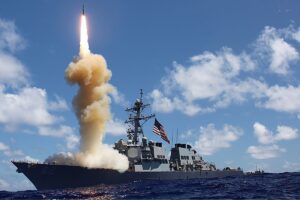
At the weekend two U.S. Navy guided-missile destroyers — the USS Frank E. Petersen Jr and USS Michael Murphy — had transited the Strait of Hormuz to pave the way for mine-clearance operations.
As per CENTCOM commander Admiral Brad Cooper on Saturday: “Today, we began the process of establishing a new passage and we will share this safe pathway with the maritime industry soon to encourage the free flow of commerce.”
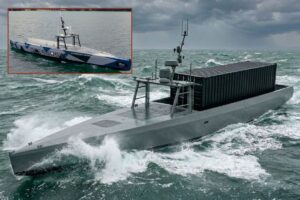
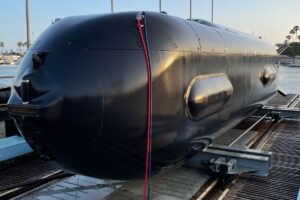
CENTCOM said in the days ahead additional U.S. forces “including underwater drones” would soon join the clearance effort.
- You can read the latest CENTCOM updates on its X social media feed and IRIB updates on its X feed