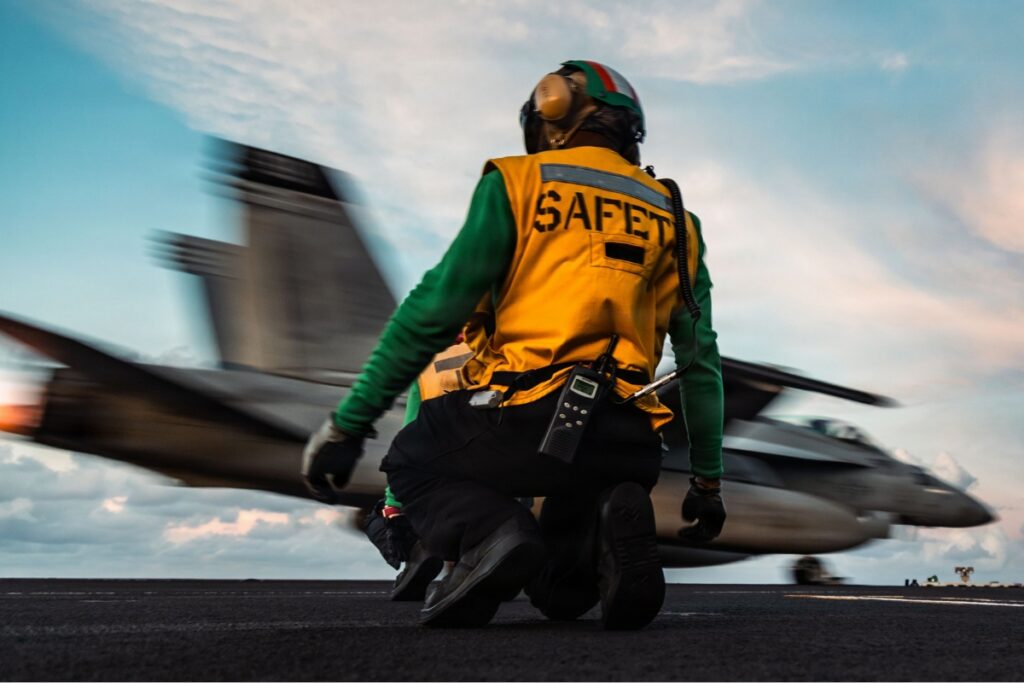
U.S. President Donald Trump has ordered Navy officials to devise a plan to replace the electro-magnetic catapults on its new Gerald R. Ford-class aircraft carrier with steam-powered ones.
Trump signed a National Security Memorandum yesterday (Thursday) directing Secretary of War Pete Hegseth and the Acting Navy Secretary Hung Cao to make the switch.
It read: “Within 60 days of the date of this memorandum, the Secretary of War, in consultation with the Secretary of the Navy, shall provide to the President, through the Director of the Office of Management and Budget (OMB) and the Assistant to the President for National Security Affairs (APNSA), a plan on the required measures to replace the Electromagnetic Aircraft Launch System and Advanced Weapons Elevators with steam and hydraulic systems for the construction of CVN-81, including timelines and resourcing requirements.”
Other measures in the same memorandum called for the establishment of a fifth Navy Shipyard “to increase nuclear-powered submarine and aircraft carrier readiness.”
It also called for Naval Sea Systems Command (NAVSEA) reforms to reduce red tape, and the establishment of a submarine Component Repair Centre to “include such resourcing requirements as necessary to maintain at least one ‘ship set’ of spare equipment for the Los Angeles, Virginia, Seawolf, Ohio, and Columbia classes.”
CVN-81 is the hull designation for the future USS Doris Miller, the U.S. Navy’s fourth Gerald R. Ford-class nuclear-powered aircraft carrier. The Ford-class carriers have four such systems to launch aircraft: two at the bow and two waist (angled deck) catapults.
The Electromagnetic Aircraft Launch System (EMALS) is widely held to offer significant operational advantages over legacy steam catapults, replacing complex pneumatic and hydraulic structures with a digitally controlled linear induction motor.
Software-controlled electric power allows operators to set precise individual launch speeds, making it easier to scale down to safely launch lighter airframes such as uncrewed aerial systems (UAS) without tearing them apart.
The EMALS system is also capable of delivering up to up 121 megajoules of energy, making roughly 30% more powerful than the legacy steam system it replaced, and thus easier to launch heavily-armed fighters.
EMALS is supplied by General Atomics; in a statement it said Trump’s decision to revert to steam “warrants careful reconsideration.”
It told a U.S. media outlet that work on the catapults on the future USS Doris Miller was about half-finished and that such a redesign would mean increased costs and delays.
Trump had first mooted the idea of steam-powered catapults in an interview in Time magazine in 2017; he reportedly believes the steam-powered system is less complex and easier to fix.
- You can read the National Security Memorandum on the White House website