The Royal Navy has trialled air-dropping the Kraken uncrewed surface vessels (USVs) it has procured under Project Beehive in a series of North Sea tests.
The K3 Scout drone boats were successfully dropped and deployed onto the waves from a height of 1,300ft. An RN press statement dubbed the trial “The first airdrop of its kind from a military transport aircraft.”
Across a six-day period the USVs were successfully deployed from the cargo bay of a four-engine turboprop Airbus A400M Atlas a total of four times.
Having slid out of the plane’s rear hatch in flight, they parachuted down onto the sea’s surface and began sailing without the need for external intervention of any kind. The drone boats started operating as anticipated in Sea State 4 conditions, with waves up to 8ft high.
The RN statement noted: “These demonstrations… proved that a crewless boat can both survive an airdrop and then operate without the need for a support ship or a nearby port – valuable progress as the Royal Navy continues to embrace uncrewed and autonomous technology.
“By proving it can be airdropped, it instantly expands the speed, range, and flexibility with which uncrewed maritime capabilities — such as those procured under Project Beehive — can be deployed.”
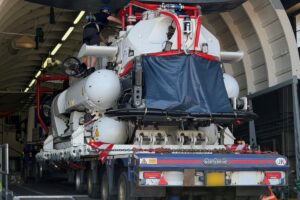
The trials were carried out by the RN in cooperation with teams from Kraken Technology Group and Capewell, which supplies the Universal Maritime Craft Aerial Delivery System (UMCADS), the sled delivery mechanism for the drones.
Captain Adam Ballard of Project Beehive said: “One of the limitations of small USVs is their ability to self-deploy and so we are actively looking at concepts for deployment from motherships or ‘mother aircraft’.
“The recent air dispatch trials that Kraken have conducted show the potential of this capability to rapidly deploy globally… Since the earliest aircraft carriers and seaplane tenders we have become accustomed to air power deploying from maritime power. We are now moving to a future where maritime power can be deployed from air power.”
Kraken CEO Mal Crease commented: “We have demonstrated that K3 Scout can be rapidly deployed directly from a military transport aircraft into contested or difficult-to-access waters ready for operation.
“Kraken alongside Project Beehive will continue to push boundaries to deliver novel and enhanced operational capabilities with our resilient, modular platforms.”
And Capewell’s Director of Business Development and Training Mark Lavender added: “We were able to validate the integration of a complex payload with our UMCADS platform while demonstrating the ease with which the system can be reconfigured for alternative mission essential equipment be they maritime or land applications.”
- You can read more details on the Royal Navy website