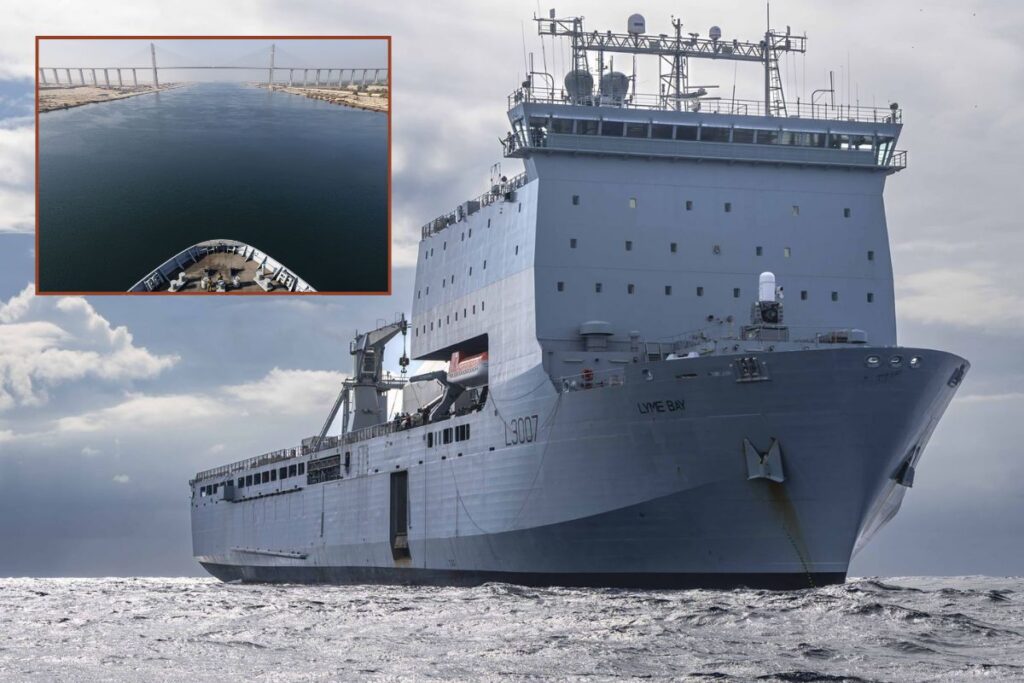
Newly converted minehunting mothership RFA Lyme Bay has joined Royal Navy Type 45 destroyer HMS Dragon in the Middle East ready for duties in the Strait of Hormuz.
The Bay-class dock landing ship has transited the Suez Canal having spent the last few weeks in Gibraltar being refitted to serve in a mine countermeasures (MCM) command role for autonomous systems.
She was watched over during her passage by HMS Dragon, which has been operating in the region for the last few weeks as part of the carrier strike group led by French flagship Charles de Gaulle.
Also making the transit towards the Gulf alongside RFA Lyme Bay were German command and support ship FGS Mosel and minehunter FGS Fulda; the 140-strong German force is equipped with autonomous systems, mine clearance divers and vessel protection teams.
As per an RN press statement, embarked on RFA Lyme Bay are more than 270 personnel including over 100 Royal Navy mine warfare and diving/explosive ordnance disposal experts, plus medics, Royal Marines, British Army soldiers and French sailors.
Specialist MCM kit aboard include least two classes of crewless/autonomous boats, capable of launching towed sensors or remotely-operated submersibles autonomous 2D/3D sonar systems; one of them is RNMB Ariadne.
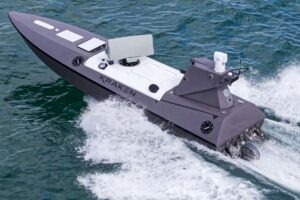
Other assets include Video Ray Defender-Viper portable mine disposal submersibles, capable of locating, identifying and destroying mines, and potentially some of the RN’s first K3 Scout uncrewed surface vessels (USVs) supplied by Kraken Technology Group under Project Beehive, which are capable of 55 knots and suitable for both strike and ISR missions.
The ships are ready to play a role in a potential Anglo-French-led mission involving over 40 nations to clear mines and secure freedom of navigation for commercial shipping in the Strait of Hormuz, assuming the ceasefire between America and Iran holds. It’s estimated just under 500 cargo ships remain trapped waiting to transit the critical waterway.
Royal Navy U.K. Mine Countermeasures Force Commander Gemma Britton commented: “A huge number of people from across Defence and industry have worked exceptionally hard over the past few weeks to bring together experts and cutting edge mine detection and clearance technology on to Lyme Bay.
“We’ve trained hard and are enormously keen to utilise our skills on live operations that have such significance, not just to families and friends at home, but around the globe. This will be a multinational effort; the Royal Navy is ready to deliver.”
RFA Lyme Bay’s Commanding Officer Captain Simon Herbert commented: “Collectively this has been a whole ship effort: RFA, Royal Navy, Royal Marines, British Army, and our international colleagues. I am very proud of the determined contribution of everyone on board in enabling the ship to deploy safely to the Middle East and be ready for the potential mission ahead of us.”
And HMS Dragon’s Commanding Officer Commander Iain Giffin added: “Supporting the arrival of RFA Lyme Bay and our German partners into the region is a key step in the multinational effort to restore freedom of navigation in the Strait of Hormuz.
“HMS Dragon is proud to provide area air defence to the task group as they transit through the Red Sea and beyond in order to carry out their vital mine clearance mission.”
- You can read more details on the Royal Navy website