The Royal Netherlands Navy (RNLN) has been putting its emerging uncrewed systems doctrine to the test with a series of trials in the North Sea.
Over the past five weeks since June 1, its Maritime Uncrewed Sea Trials (MUST) have seen experiments carried out with uncrewed maritime and air systems.
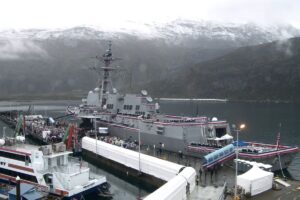
Navy Leaders attended a visitors’ day staged today (Wednesday), which included demonstrations aboard and around its Rotterdam-class landing platform dock (LPD) HNLMS Johan de Witt in the waters off the Den Helder naval base.
It also featured a presentation by the RNLN on the thinking behind the doctrine and MUST26’s preliminary findings.
Developed by the RNLN’s Maritime Uncrewed Taskforce, its “Future Vision Maritime Uncrewed” plan was published at the end of April. It envisions uncrewed systems at the fore taking on missions characterised by three “D”s: dangerous, difficult, and decisive.”
It’s structured around seven key themes: naval mine warfare; anti-submarine warfare; integrated air and missile defence; amphibious/littoral operations; special ops; maritime strike; and North Sea and Caribbean protection.
In the longer term goal, during the decade beginning 2040 onwards the goal will be to start deploying more and more autonomous combat networks across widely distributed areas, rather than small concentrations of crewed assets.
To help the transition, the RNLN intends to collaborate closely with both academia and industry partners to develop what it has dubbed a “smart maritime ecosystem.” This will include enhancing production capacity via innovative techniques including additive manufacturing (aka 3D printing) and robotics.
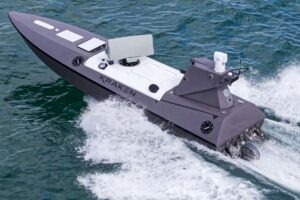
Two 12-metre USVs made by IMPACD Boats, each 3D-printed in under two weeks and outfitted to a similar timeframe, were used in today’s demonstration. A Shield AI V-BAT uncrewed aerial system (UAS) was also deployed as part of the UxS mix.
At the visitor day today Maritime Uncrewed Systems Programme Director Bas Buchner said this year’s trials had just been the start. He said this year’s MUST exercises had been a test of hardware, software, and concepts of operations (CONOPS) all at once, and going forward, the approach would be: “Accelerate, and deploy, and keep developing, because the threats will be changing.”
Today’s demonstration included conducting formation operations with two USVs around HNLMS Johan de Witt, used as the target platform.
A multidomain “find” mission including search, detect, escort, identify, locate and track tasks was successfully accomplished, using multiple assets controlled from a common command-and-control (C2) platform. And a Lobster Robotics UUV was deployed from a USV to identify and inspect an undersea pipeline.
Operational challenges overcome on the day were typical of the five-week series as a whole; organisers said one of the key takeaways from this year’s MUST series was: “Things go wrong. Learn from it, and go on.”
Other initial findings summarised at the end of the day included validation of the efficacy of short, iterative innovation cycles, which should become “the new normal.”
There was a recognition of the inherent value of hands-on operational experimentation, and a recommendation that technical, operational and legal aspects should be brought together in works going forward.
The importance of pre-test checks and robust components was stressed, as was redundancy of systems to minimise and work round unanticipated failures.
And the strong influence of environmental factors on operational performance was acknowledged, with wind, cloud, rain and waves having significant impacts on systems’ performance.
Dutch uncrewed systems are being designed for blue-water use in harsh conditions such as those presented by the North Sea; it has been recommended that future tests should also be conducted in Arctic and Caribbean waters, which will both offer differing and unique experimental conditions.