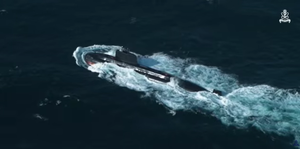
A revised version of the Herne XLAUV developed by BAE Systems and Cellula Robotics is expected to be market-ready for military customers by the end of 2026.
The British defence prime announced a new ten-year collaboration agreement with the Canadian firm to work on the uncrewed submarine to coincide with last week’s DSEI 2025 show in London.
Navy Leaders is given to understand the revised platform will feature a reconfigured modular payload bay which will help maximise capacity, and a reworked profile to help minimise its signature in the water.
You can read our in-depth report on Herne following our visit to the platform’s trials in November 2024 off the south coast of England here: Deep Dive: Herne XLAUV
The drone submarine, or extra large autonomouus underwater vehicle (XLAUV) has been designed to conduct various missions from anti-submarine warfare (ASW) and covert surveillance to port safeguarding and protection of critical underwater infrastructure (CUI).
Managing Director of BAE Systems’ Maritime & Land Defence Solutions business Scott Jamieson commented: “The trials last year were a huge success and I’m delighted that we’re building on that momentum with this new collaboration agreement to maintain the phenomenal pace at which we’re developing Herne.
“It’s a game changer in the underwater battlespace and will enable us to offer our customers a cost-effective autonomous capability providing them with more endurance, efficiency and scale, whilst keeping their people out of harm’s way.”
And Chief Executive Officer of Cellula Robotics Neil Manning added: “Herne, the result of this partnership, embodies the fusion of cutting-edge engineering from both companies to create a platform with unmatched endurance and operability, setting it apart from others in the field.
“At Cellula, we believe Herne, powered by our hydrogen-based energy solution, represents a cost-effective force multiplier. It helps to fill an essential gap, complementing navies’ operational needs while seamlessly integrating with other marine defense systems.”
- You can read more details on the BAE Systems website and the Cellula Robotics website