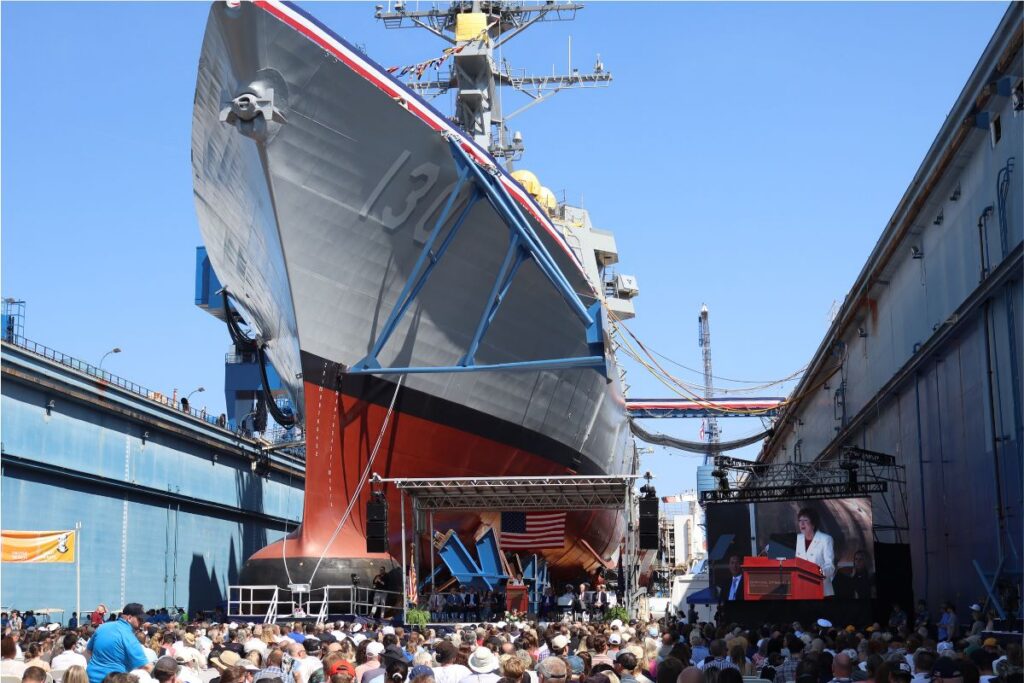
New U.S. Navy Arleigh Burke-class guided missile destroyer USS William Charette has been christened at General Dynamics Bath Iron Works (GDBIW) in Brunswick, Maine.
Construction work on the warship, the fifth Flight III variant, began in late 2020. The typical gap between the christening/launching of an Arleigh Burke-class destroyer and her official commissioning is between 18 and 30 months.
Next will come her final outfitting phase: once the ship is in the water, workers will complete internal wiring, hook up the Aegis Combat System, and finish the living spaces.
Crew boarding begins up to a year before her scheduled commissioning into active operational service. Ahead of this USS William Charette will have to complete three to six months of sea trials; these are currently scheduled to begin in late 2027 or early 2028.
At Saturday’s christening ceremony, acting Secretary of the Navy Hung Cao said: “Serving as the shield of the fleet, protecting the Carrier Strike Group from air and missile threats and maintaining open sea lanes for maritime commerce — this premier surface combatant will be a cornerstone of America’s new Golden Fleet.”
The warship is named after Korean War veteran and Medal of Honor recipient William Charette, a medic who while serving with a USMC rifle company, repeatedly exposed himself to heavy enemy fire to aid wounded Marines.
Flight III Arleigh Burke-class destroyers are 155 metres long, displace almost 10,000 tons fully loaded, are capable of more than 30 knots, and feature a 96-cell vertical launch system (VLS) for Tomahawk, SM-2, SM-3, and ESSM missiles.
They are equipped with Raytheon’s AN/SPY-6 Active Electronically Scanned Array (AESA) radar, more than 30 times as sensitive as the SPY-1D passive radar legacy system it has supplanted.
They operate the Aegis Baseline 10 Combat Management System with enhanced tracking capacity and range, allowing a ship to simultaneously monitor complex, fast-moving ballistic and air defence threats.
While real-world operational tracking capacity is classified, the system has the theoretical capacity to track up to 24,000 objects simultaneously across its four-sided array.
- You can read more details on the U.S. Navy website