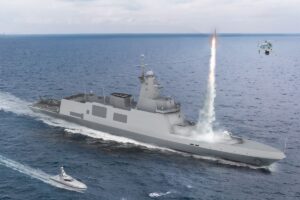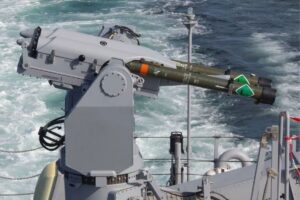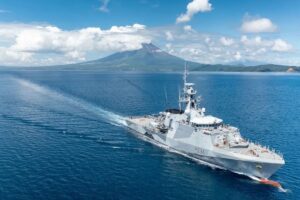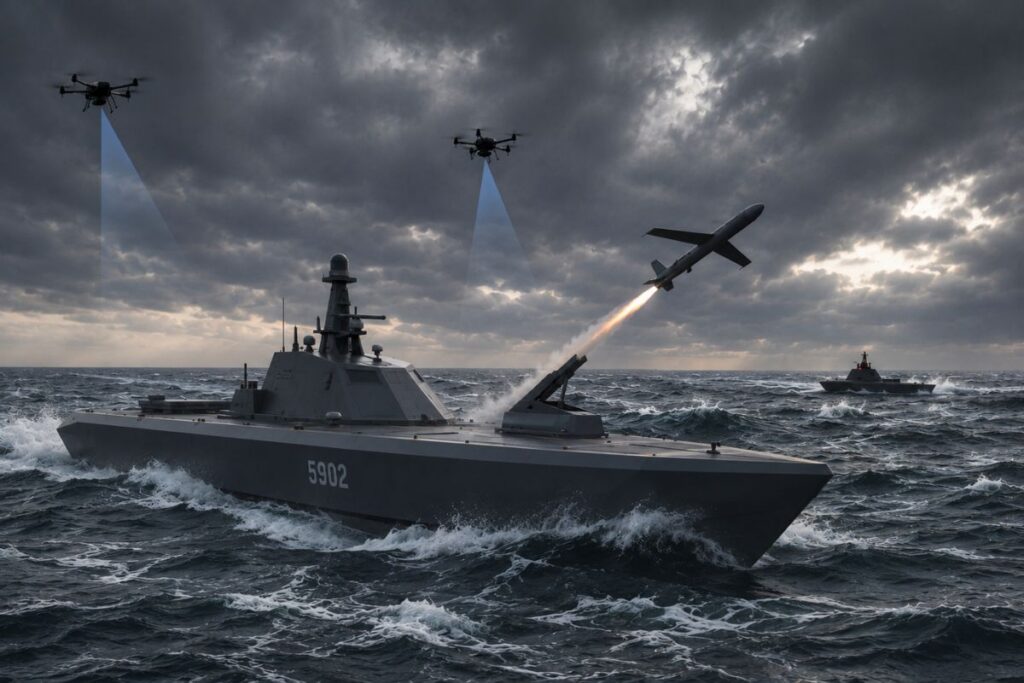
The U.S. Navy wants firms to come forward with low-cost uncrewed surface and air systems which can help fend off drone attacks in an affordable way.
The Suitable Warfighting Adaptive Payloads (SWAP-USV) is a new solicitation issued by the Defense Innovation Unit (DIU), a U.S. Department of War (DoW) organisation founded in 2015 to accelerate the military’s adoption of commercial technology.
The SWAP-USV problem statement reads: “The cost-exchange ratio for detecting and neutralizing asymmetric maritime threats in contested environments is heavily skewed in favor of the adversary. Bad actors deploy low-cost, low-signature threats — including explosive Unmanned Surface Vessels (USVs), Group 1–3 Unmanned Aircraft System (UASs), “go-fast” smuggling boats, and semi-submersibles.
“Currently, the DoW relies on exquisite, multi-million-dollar naval and aviation assets to intercept these inexpensive targets. The Government requires affordable, scalable, production-ready maritime systems capable of persistent search, tracking, and operational effects against asymmetric threats.
“The Government seeks… combinations of USVs and UASs that maximize operational effectiveness while improving the cost-exchange ratio across a range of mission profiles.”
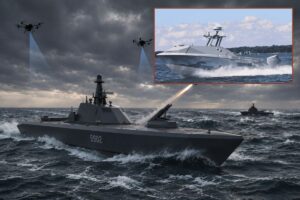
The DIU wants firms to come forward with USV solutions which can carry, launch, and control at least two UAS capable of kinetic strike with a minimum 2kg payload, and which can carry out battle damage assessment (BDA).
The USV must have a minimum operational range of 200 nautical miles and a sustained cruise speed of at least 10 knots. Its embarked UAS must include a mix of recoverable/reusable drones and one-way effectors (OWE).
The aerial drones need to be able to navigate to user-defined waypoints, patrol designated areas, loiter on station, and reposition in response to operator commands or mission objectives.
They have to be equally at home on the open ocean or in littoral, and brown water environments.
Successful companies will be in line for funding via an Other Transaction Agreement (OTA) award process, with up to $100 million in funding available.
The DIU stated: “This competition will be executed as a 12-Month Prize Challenge with rolling submission windows divided into three Sprint cohorts.”
The deadline for submissions for Sprint 1 is just before midnight U.S. Eastern time on August 10.
- You can read more details on the DIU website